

When homeowners ask how often should you flush a water heater in NJ, most storage-tank models need it about once a year. Homes with hard water, well water, high hot-water demand, or recurring sediment may need service about every six months. Your manufacturer’s instructions for your exact model should always take priority over any general rule. The EPA notes that many manufacturers recommend yearly flushing, so annual service is a helpful baseline and not a legal requirement.
- Typical homes: Once per year with municipal water and moderate hot-water use.
- Harder conditions: About every six months with hard water, well water, or visible mineral buildup.
- Tankless units: Usually annual descaling, which is different from a tank flush.
- Older or neglected tanks: Have a licensed plumber inspect the unit before any flushing.
Flushing an old, neglected heater can reveal existing corrosion or cause a weak drain valve to leak. The flush does not damage a sound tank, but it can expose a problem that was already there.
If you are unsure which schedule fits your home, our water heater services team can inspect the unit and recommend a safe interval. You can also read our guide to water heater repair in Warren, NJ to see which problems sediment can cause.
Why Water Heaters Need To Be Flushed
When homeowners ask how often should you flush a water heater in NJ, most storage-tank models need it about once a year. Over time, they form a layer of sediment that sits between the heat source and the water. The heater then has to work harder to move heat through that layer. According to PNNL, sediment can leave mineral deposits on the heating element and make it less effective at transferring heat.
As sediment builds up, it can cause several problems:
- Less usable hot water in the tank.
- Gas burners or electric elements that work less efficiently.
- Popping, crackling, or rumbling sounds during heating.
- Longer heating times.
- Extra wear on heater components.
- A clogged drain valve or interference with normal operation.
Think of sediment as a blanket on the bottom of the tank. The heat has to push through it before it can warm the water above.
Because every home has different water and usage, the effects show up at different speeds. A professional plumbing inspection can show how much buildup your system has, and our plumbing services team can handle any repairs that turn up.
How New Jersey Conditions Affect Flushing Frequency
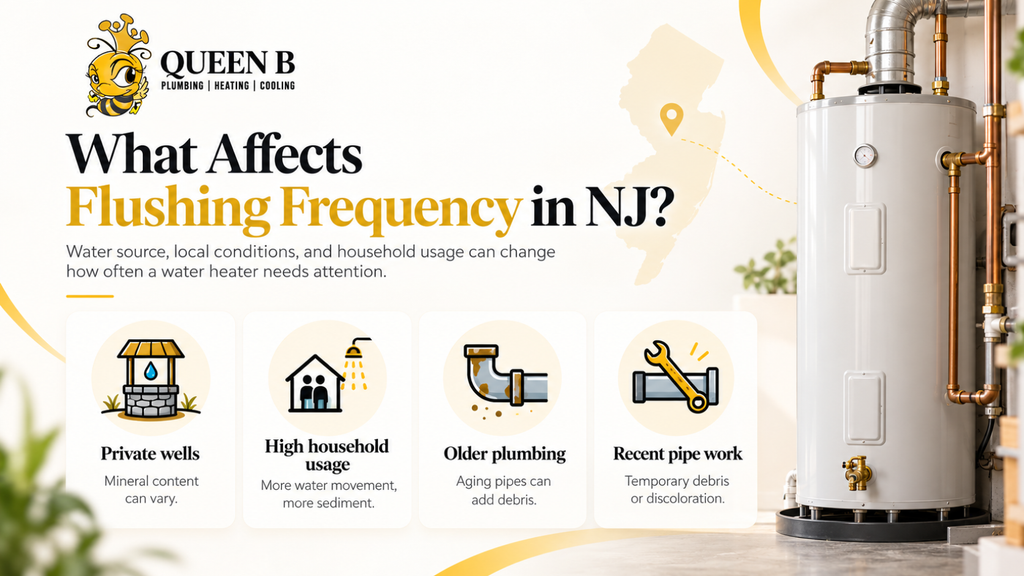
Water quality in New Jersey varies by municipality, building, water source, and plumbing system. Harder water carries more minerals, which can speed up scale and sediment buildup inside a tank. American Water New Jersey explains that hard water leaves mineral buildup that commonly settles in a water heater. For that reason, you should not assume every New Jersey home has the same water hardness.
Several local factors can change how often your heater needs attention:
- Private wells: Mineral content can differ widely from municipal water, so wells may need closer monitoring.
- High household usage: More hot water use moves more water and sediment through the system.
- Older plumbing: Aging pipes can add debris to the water supply.
- Recent construction or plumbing work: Temporary debris or discoloration may appear for a short time.
Older homes often have more than one source of debris, which our guide to plumbing problems in older Somerset County homes covers in more detail. If your home has had recent pipe work, cloudy water may show up even when the heater itself is fine.
New Jersey homeowners should not assume that one statewide flushing schedule fits every home. The question of how often should you flush a water heater in NJ comes down to your water source, local water chemistry, heater type, household size, and maintenance history.
We serve Warren, Hunterdon, Somerset, Middlesex, and Morris County, including Bridgewater, Flemington, Morristown, South Plainfield, and Livingston. Our technicians can help you set a flushing schedule that fits your local water conditions.
Signs Your Water Heater May Need Flushing
Your water heater often gives warning signs before sediment becomes a bigger problem. Most of them show up as strange sounds, changes in hot water, or odd-looking water from the tap. Catching them early can help you schedule maintenance before a small issue turns into a repair. Here are the most common signs to watch for:
- Popping, banging, crackling, or rumbling sounds from the tank.
- Less hot water than usual.
- Water that takes longer to heat.
- Cloudy, rusty, or discolored hot water.
- Sediment or grit coming from hot-water fixtures.
- Repeated heating-element or burner problems.
- A leaking or corroded drain valve.
- A heater with no documented maintenance history, especially an older unit.
- A tankless unit showing a service or scale warning.
These symptoms do not prove that sediment is the only cause. They can also point to a failing heating element, thermostat, burner, dip tube, anode rod, relief valve, or tank.
If grit or weak flow is the main issue, our guide to low water pressure in Warren, NJ homes can help you rule out other causes. A leaking tank or a rusty, corroded drain valve is different, so see our tips on what to do before an emergency plumber arrives.
Storage Tank Vs. Tankless Water Heater Maintenance
Storage-tank and tankless water heaters need different kinds of care. A tank heater collects sediment at the bottom, so it is drained and flushed. A tankless heater has no tank, so its heat exchanger is cleaned with a descaling solution instead. Which maintenance applies, and how often should you flush a water heater in NJ, depends on which type you own.
| Heater Type | Maintenance Task | Typical Baseline |
| Gas or electric tank | Drain and flush sediment | About annually |
| Tankless heater | Descale the heat exchanger | Often annually |
| Tank with hard water or well water | More frequent sediment removal | Often every six months |
| Any heater with an active leak | Professional diagnosis | Do not rely on flushing |
Tankless units are not usually flushed the same way as tank heaters. They are commonly descaled by circulating a cleaning solution through the heat exchanger.
A New Jersey plumbing guide also separates tankless descaling from tank flushing and recommends following the exact maintenance instructions for your model. If you have questions about your own unit, our FAQ page is a good place to start.
Can You Flush A Water Heater Yourself?
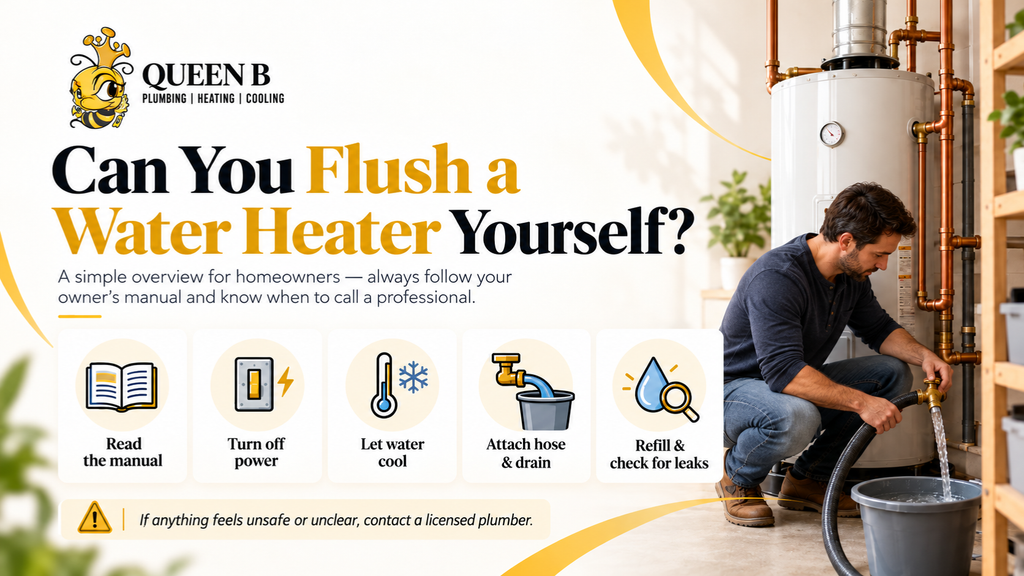
Many homeowners can flush a storage-tank water heater themselves if the unit is in good shape. The job involves hot water, gas or electricity, and pressure, so it is not right for everyone. Reading your owner’s manual first is the most important step, because procedures differ between models. If any part of the process feels unsafe or unclear, it is wise to hand the job to a licensed plumber.
Here is the general process for a storage-tank heater:
- Read the owner’s manual.
- Turn off the gas burner or electrical power using the correct procedure.
- Let the water cool.
- Shut off the cold-water supply.
- Connect a properly rated hose to the drain valve.
- Route the discharge to a safe spot that can handle very hot water.
- Open a hot-water faucet to relieve pressure and let air into the tank.
- Drain and flush the tank following the manufacturer’s instructions.
- Close the drain, refill the tank completely, and check for leaks.
- Restore gas or electrical service only after the tank is full and the correct restart procedure is followed.
The New Jersey Department of Health advises flushing until the water runs clear and free of sediment. Keep in mind that these steps are a general overview and not a replacement for your manufacturer’s instructions.
If you would rather not take on the work, you can meet the licensed professionals on our team who handle water heater maintenance every day. They can flush the tank, check the drain valve, and spot problems you might miss.
Safety Warnings
Flushing a water heater is a simple job on paper, but it involves several real hazards. Scalding water, gas, electricity, and pressure are all present at the same time. A small mistake, such as restoring power before the tank is full, can damage the heater or cause injury. Taking a few minutes to review the safety rules before you start is always worth it.
Safety Warning: Water from a heater can cause severe burns. Do not discharge it where it can contact people, pets, landscaping, electrical equipment, or surfaces that may be damaged.
Keep these precautions in mind throughout the process:
- Never turn on an electric tank heater while it is empty or partially empty.
- Do not bypass safety controls.
- Stop if the drain valve will not close, the tank leaks, or the discharge stays heavily contaminated.
- Do not test or manipulate the temperature-and-pressure relief valve casually.
- Hire a licensed plumber if you are uncomfortable working around gas, electricity, pressure, or scalding water.
If you ever smell gas near your heater, leave the area and call your gas utility or emergency services right away. Gas-fired equipment should only be serviced by a qualified professional, such as our heating services technicians.
When something does not look right during a flush, stopping early is always the safest choice. You can contact Queen B Plumbing to have a technician take over and finish the job safely.
When Flushing An Old Water Heater Can Be Risky
A neglected or heavily corroded heater may have a failing drain valve or a weakened tank. Flushing can expose an existing leak, but it does not cause a sound tank to fail. The process simply reveals a problem that was already developing. That is why age and condition matter before you open the drain valve.
Call a professional for an inspection first if any of these apply:
- The unit is roughly 8 to 10 years old or older.
- The tank shows rust, corrosion, or moisture.
- The heater has never been flushed.
- The drain valve is damaged or stuck.
- The water is heavily contaminated with rust or scale.
- There is already a leak.
- You cannot safely shut down or restart the system.
Many conventional tanks reach the later part of their service life around this age range. Actual life varies by model, water quality, installation, and maintenance.
Corrosion inside a heater can also point to wider problems in your home’s piping. Our guide on when to replace plumbing pipes explains the signs that pipes may be reaching the end of their life.
If an inspection shows the tank is near the end of its life, flushing will not repair it. Replacement can feel like a big expense, so it helps to know about financing for home upgrades before you decide.
How Often Should A Tankless Water Heater Be Flushed?
Tankless water heaters do not hold a tank of water, so they do not collect sediment the way storage heaters do. Instead, minerals can build up as scale inside the heat exchanger, especially in homes with hard water. Many tankless systems need descaling about once a year. Hard water and heavy use can justify more frequent service, so the right schedule depends on your home and your model.
Keep these points in mind for tankless maintenance:
- Follow the manufacturer’s instructions for the cleaning solution, isolation valves, and flushing steps.
- A tankless flush is not the same as draining a tank heater.
- Hard water and high usage may call for service more often than once a year.
- Units without service valves usually need a professional to add them before descaling.
A professional can also inspect filters, isolation valves, ignition components, and error codes while servicing the unit. That extra check can catch small issues before they cause a breakdown.
Scale warnings on the display are easy to ignore, but they are a good reason to schedule service soon. You can read what other homeowners say about our work on the testimonials page, and check our savings page for current offers on maintenance.
Other Water Heater Maintenance Tasks
Flushing is only one part of keeping a water heater healthy. A quick routine check a few times a year can catch leaks, corrosion, and worn parts before they cause damage. Most of these tasks take only a few minutes and need no special tools. Use this checklist alongside your owner’s manual and warranty requirements:
- Inspect the tank and connections for leaks and corrosion.
- Check the drain valve and visible fittings.
- Inspect the anode rod according to the manufacturer’s schedule.
- Confirm the temperature setting suits your household.
- Keep combustible materials away from gas appliances.
- Check expansion-tank and pressure-related concerns where applicable.
- Review the owner’s manual and warranty terms.
- Schedule a professional inspection when performance changes.
Be careful with temperature changes. Federal guidance treats Legionella control and scald prevention as separate concerns, so avoid a blanket change without weighing scald risk and household needs.
If your home also has a boiler, the same habit of regular checkups applies to our boiler services. Heaters in unheated basements or garages are also worth a look before winter, and our guide to frozen pipe prevention for Somerset County homeowners explains how to protect nearby pipes.
When To Call A New Jersey Plumber
Some water heater problems are too risky or too complex to handle on your own. Gas, electricity, high pressure, and scalding water can all be involved in even a simple repair. A licensed plumber can find the real cause of a problem and fix it safely. Call a professional if you notice any of the following:
- The water heater leaks.
- There is no hot water.
- You smell gas near the unit.
- The unit repeatedly trips a breaker.
- The discharge is rusty, oily, or unusually foul-smelling.
- The drain valve is stuck.
- The tank is old and has never been serviced.
- The heater sits in a hard-to-drain location.
- You are unsure whether the tank is full before restoring power.
- The heater is still noisy after flushing.
- A tankless unit needs descaling but lacks service valves.
If you smell gas, leave the area first and then call for help. Gas leaks are always an emergency.
Wondering what a service call might involve? Our guide on how much a plumber costs in Warren, NJ explains what affects the price of a visit, and our past work page shows the kinds of jobs we complete across the area.
If your water heater is noisy, producing discolored hot water, or overdue for maintenance, Queen B Plumbing, Heating & Cooling can inspect the system and recommend the safest next step. Call 908-633-1333 to schedule service.
We also offer many other home comfort solutions, which you can browse on our all services page. Our licensed team serves Warren, Hunterdon, Somerset, Morris, and Middlesex counties.
Links used so far: EPA, Water Heater Services, Water Heater Repair in Warren NJ, PNNL, Plumbing Inspection Checklist, Plumbing Services, American Water NJ, Plumbing Problems in Older Somerset County Homes, Morris County, Bridgewater, Flemington, Morristown, South Plainfield, Livingston, Low Water Pressure in Warren NJ, Emergency Plumber in Warren NJ, PW Group NJ, FAQ, NJ Department of Health, Our Team, Heating Services, Contact Us, When to Replace Plumbing Pipes, Financing for Home Upgrades, Testimonials, Savings, Boiler Services, Frozen Pipe Prevention, How Much Does a Plumber Cost, Past Work, All Services.
Ready for Section 12 (Frequently Asked Questions)? Links still unused: Air Conditioning Services, Oil to Gas Conversion, Mini Split Installation, Bathroom Renovations, Heating Services Somerset County, Drain Cleaning, Emergency Sewer Line Repair, Blog, and Home.

Schedule Your Water Heater Inspection In Warren, NJ
The answer to how often should you flush a water heater in NJ is a schedule that catches sediment, leaks, and worn parts early. Flushing your water heater on the right schedule helps you catch sediment, leaks, and worn parts early. Most storage-tank heaters do well with a yearly flush, while hard water, well water, or heavy use may call for service every six months. Tankless heaters need descaling instead, and older or neglected tanks should be inspected before anyone opens the drain valve. If you are not sure where your heater stands, a professional visit takes the guesswork out of it.
Queen B Plumbing, Heating & Cooling serves Warren, Hunterdon, Somerset, Morris, and Middlesex counties. Call 908-633-1333 to schedule an inspection or water heater service today.


