If you’re searching for water heater repair in Warren, NJ, you’re likely dealing with anything from a simple part replacement to a more involved repair. The right approach depends on several factors — the type of heater you have, which component has failed, how accessible the unit is, labor requirements, whether you need emergency service, and whether the tank itself has been compromised. Because these variables differ from home to home, a professional diagnosis is the only reliable way to get an accurate estimate for your specific situation.
A water heater problem doesn’t just mean cold showers — it can disrupt laundry, dishwashing, and other daily routines that depend on reliable hot water heater services. Getting the issue diagnosed and resolved quickly helps minimize that disruption and prevents smaller problems from turning into bigger ones.
How Much Does Water Heater Repair Cost in Warren, NJ?
Water heater repair costs in Warren, NJ can vary quite a bit depending on the specific problem and the type of system involved. Published cost estimates from industry sources offer a useful starting point, but they should be treated as general planning ranges rather than fixed prices. The table below breaks down typical cost ranges for common repairs, though your actual price will depend on the diagnosis.
| Repair or Service | Planning Range |
| Diagnostic or service visit | Approximately $65–$150 |
| Thermostat replacement | Approximately $150–$300 |
| Pilot light, thermocouple, or ignition repair | Approximately $150–$300 |
| Heating element replacement | Approximately $200–$400 |
| Pressure-relief valve replacement | Approximately $150–$300 |
| Tank flushing or sediment service | Approximately $100–$250 |
| Leak repair at fittings or connections | Approximately $150–$600 |
| Tankless water heater repair | Approximately $300–$1,300 |
One New Jersey-focused cost source lists typical water heater repairs ranging from $150 to $600, noting that the exact cost depends on the specific component and how severe the problem is. Another source puts the average New Jersey diagnostic fee at around $64, with an average repair cost near $333.
Actual pricing depends on the diagnosis, the age and type of your unit, the parts needed, installation complexity, code requirements, and whether you’re requesting service outside normal business hours. Several distinct cost factors typically make up your final bill, and understanding them can help you make sense of any quote you receive.
- Diagnostic fee — the cost of identifying the problem
- Labor — time and expertise required for the repair
- Parts — replacement components needed for the fix
- Permit or code-related work — where applicable to your repair
- Disposal or replacement-related charges — if old components need removal
- Emergency or after-hours service — additional cost for urgent calls
We can’t quote an exact price without seeing your unit, but a technician can give you a firm estimate once they’ve diagnosed the issue in person.
Common Water Heater Problems
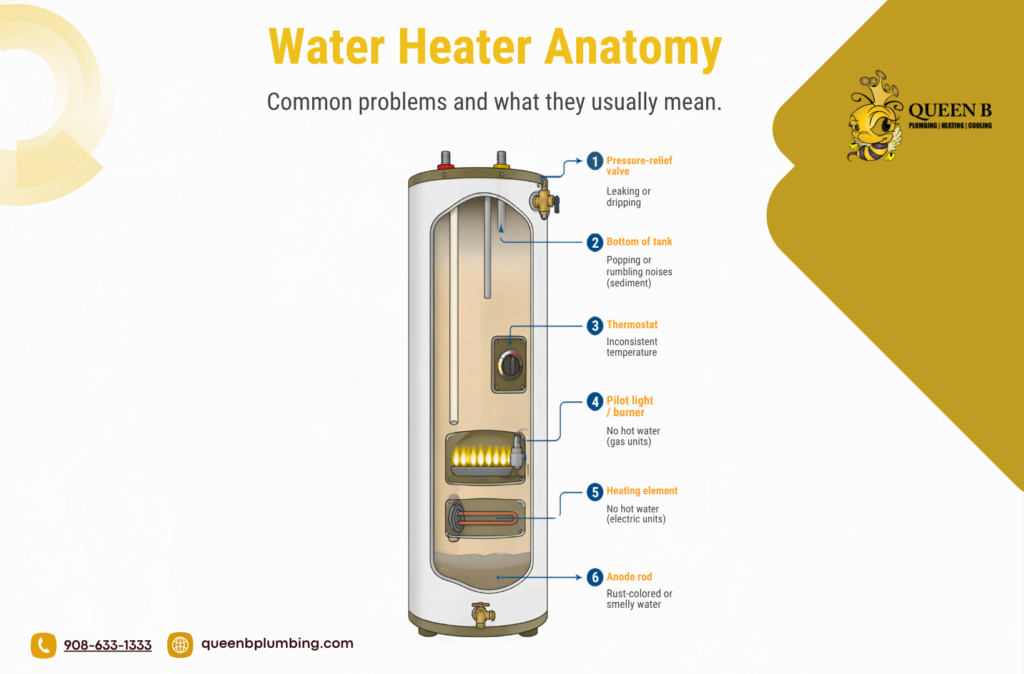
Water heater issues tend to show up as one of a handful of recognizable symptoms, and understanding what each one means can help you decide how urgently to act. Below, we’ve broken down the most common problems Warren homeowners run into when they need water heater repair in Warren, NJ, along with what typically causes them and whether they call for immediate attention. Each section also covers what a plumber will likely inspect once they arrive.
No Hot Water
Having no hot water at all is one of the most common water heater complaints, and it can stem from several different causes depending on your system type. Electric units often lose hot water due to a tripped breaker, a failed heating element, or a defective thermostat, while gas units may have a pilot light or ignition failure, a gas supply issue, or a malfunctioning control board. Sediment buildup can also interfere with heating in either type of system.
If troubleshooting doesn’t resolve the issue, our water heater repair team can identify the exact cause. Homeowners can safely check whether an electric heater’s breaker has tripped, but should not attempt to dismantle gas controls or perform any combustion-related repairs themselves. , but should not attempt to dismantle gas controls or perform any combustion-related repairs themselves. If you smell gas at any point, leave the area immediately and contact your gas utility or emergency services.
A plumber may inspect:
- Heating elements and thermostats (electric units)
- Pilot light and ignition components (gas units)
- Electrical connections and breakers
- Gas supply lines
- Sediment buildup inside the tank
Water Heater Leaking
A leak can come from several different sources, and where it’s coming from matters a lot for figuring out whether you need a simple repair or a full replacement. Loose inlet or outlet connections, a leaking drain valve, or a pressure-relief valve discharge are often straightforward fixes. A leak from the tank body itself, on the other hand, usually points to internal corrosion and often means the tank needs to be replaced rather than repaired.
It’s also worth noting that condensation can sometimes be mistaken for a leak, especially on humid days or when a cold water line runs near the unit. Regardless of the source, water pooling near your heater deserves prompt attention, since it can damage flooring, walls, wiring, and any nearby equipment.
Possible leak sources:
- Loose inlet or outlet connection
- Leaking drain valve
- Pressure-relief valve discharge
- Temperature-and-pressure relief valve problem
- Corroded tank
- Failed internal component gasket
- Condensation (may resemble a leak)
If your water heater is leaking, here’s what to do:
- Turn off the cold-water supply to the heater.
- Turn off power at the breaker (for electric units).
- Set a gas unit to the manufacturer’s safe “off” or pilot position, only if it can be done safely.
- Avoid touching the hot water or the unit itself.
- Call a qualified plumber.
If you smell gas at any point, don’t attempt any of these steps — leave the area right away and contact your gas utility or emergency services.
Strange Noises
Popping, banging, rumbling, or crackling sounds coming from your water heater are unsettling, but they’re usually a sign of a fairly common issue rather than an emergency. In most cases, these noises point to sediment that has settled at the bottom of the tank over time. As that sediment builds up, it creates a layer between the water and the heat source, which makes the unit work harder and can gradually reduce its efficiency.
The good news is that this is often a manageable fix rather than a sign of major trouble. That said, if the tank has significant corrosion alongside the noise, a plumber may recommend replacement instead of continued servicing.
A plumber may recommend:
- Tank flushing
- Heating-element inspection
- Burner inspection (gas models)
- Anode-rod evaluation
- Replacement, if the tank shows severe corrosion
Water Is Too Hot, Too Cold, or Inconsistent
Inconsistent water temperature is frustrating to deal with, and it can come from a few different places depending on your system. A faulty thermostat, a failing heating element, sediment buildup, or a malfunctioning mixing valve are all common culprits in tank-style units. If you have a tankless system, inconsistent temperatures may point to a recovery issue, while an undersized or overloaded system can also struggle to keep up with household demand.
It’s important never to set your water heater dangerously high in an attempt to fix inconsistent temperatures, since this can create a scalding risk. If you’re noticing temperature swings or water that feels too hot for comfort, it’s worth having a qualified professional evaluate the system rather than adjusting settings yourself.
Common causes:
- Faulty thermostat
- Heating-element problem
- Sediment buildup
- Malfunctioning mixing valve
- Undersized or overloaded system
- Recovery issue (tankless models)
Rust-Colored or Metallic-Smelling Water
Discolored or metallic-smelling hot water can be alarming, but the source of the problem isn’t always the water heater itself. Rust or corrosion inside the tank and a deteriorating anode rod are two of the most common water-heater-related causes. However, corrosion in your household piping or a broader plumbing issue can produce similar symptoms, so it’s worth paying attention to which taps are affected.
A useful way to narrow things down is to check whether both hot and cold water are affected, or just the hot side. If only your hot water looks or smells off, the water heater is the more likely source; if both are affected, the issue may point to your home’s plumbing more broadly, and a professional diagnosis is the best next step.
Possible causes:
- Rust or corrosion inside the water heater
- Deteriorating anode rod
- Corrosion in household piping
- Discolored cold water (may indicate a broader plumbing issue)
Rotten-Egg or Foul-Smelling Hot Water
A rotten-egg or sulfur-like smell coming from your hot water is unpleasant, but it usually traces back to one of two causes. Bacterial activity inside the tank is a common culprit, particularly in units that sit unused for stretches of time. A depleted anode rod — the component designed to attract corrosive elements away from the tank itself — can also be responsible for the odor.
Resolving the smell typically involves an inspection, a tank flushing, a temperature evaluation, or anode-rod replacement, depending on what a plumber finds. It’s best to avoid simply raising the temperature yourself as a fix, since this isn’t a reliable universal solution and can introduce a scalding risk.
Pilot Light Will Not Stay Lit
A pilot light that won’t stay lit is a common complaint with gas water heaters, and it usually points to one of a few underlying issues. A faulty thermocouple, a dirty pilot assembly, or a gas supply issue are frequent causes, while draft or venting problems can also prevent the pilot from staying lit. In some cases, the issue traces back to the gas control valve itself.
This is a professional-service issue rather than a DIY fix, since it involves gas and combustion components. If your pilot light keeps going out, it’s best to have a qualified plumber diagnose the cause rather than repeatedly attempting to relight it yourself.
Low Hot-Water Volume
Running low on hot water sooner than expected doesn’t always mean your water heater is broken — sometimes it’s a matter of sizing or maintenance rather than a failure. Sediment buildup can reduce your tank’s effective capacity, while a failed heating element or a broken dip tube can also limit how much hot water is available. Incorrect thermostat operation and household demand simply exceeding the unit’s capacity are common causes as well.
Tankless systems have their own version of this issue, often related to flow restrictions or scale buildup inside the unit. If you’ve noticed your hot water running out faster than it used to, a plumber can help determine whether the fix is maintenance, a repair, or a system that’s simply undersized for your household’s needs.
Possible causes:
- Sediment reducing tank capacity
- Failed heating element
- Broken dip tube
- Incorrect thermostat operation
- Demand exceeding the unit’s capacity
- Tankless flow or scale problem
Gas, Electric, and Tankless Repair Differences
The type of water heater you have plays a big role in what repairs might be needed and what safety precautions matter most. Gas, electric, and tankless systems each have their own common failure points, from ignition components to wiring to scale buildup. The table below breaks down what to expect from each system type.
| System | Common Repair Concerns | Important Safety Point |
| Gas tank | Pilot, thermocouple, burner, gas valve, venting, sediment | Gas and combustion work should be handled by a qualified professional |
| Electric tank | Heating elements, thermostats, wiring, breakers, sediment | Shut off electrical power before any inspection beyond basic visual checks |
| Tankless | Scale buildup, flow sensor, ignition, heat exchanger, filters | Maintenance and descaling requirements vary by manufacturer |
No matter which system you have, the right diagnosis depends on the specific equipment model, its age, how it was installed, and the symptoms you’re experiencing. A plumber familiar with all three system types can pinpoint the issue more accurately than general troubleshooting alone.
Repair or Replace Your Water Heater?
Deciding whether to repair or replace a water heater isn’t as simple as looking at its age — several factors need to be weighed together to make the right call. In many cases, repair is the more practical option, while in others, replacement ends up being the smarter long-term investment. The lists below break down the situations where each option tends to make more sense.
Repair may be reasonable when:
- The tank is not leaking
- The unit is relatively well maintained
- The problem is limited to a replaceable component
- Parts are available
- Repair cost is materially lower than replacement
- The heater still meets the household’s capacity needs
Replacement may be more appropriate when:
- The tank itself is leaking or badly corroded
- Repairs are recurring
- The unit is near the end of its expected service life
- Replacement parts are obsolete or difficult to obtain
- The heater is unsafe, inefficient, or improperly vented
- A repair would approach the cost of a new, properly installed system
New Jersey replacement estimates commonly fall in the range of $1,200 to $4,500 or more, though the actual cost depends heavily on the system type and installation requirements. This range should be treated as a broad planning figure rather than a quote, since your specific situation may fall outside it in either direction.
A simple example can help illustrate the difference: a failed thermostat on an otherwise sound tank may justify a repair, since the fix is isolated and cost-effective. Water leaking from the tank seam, however, usually points toward replacement, since replacing the tank itself isn’t a practical component repair.
What to Do Before the Plumber Arrives
A little preparation before your plumber shows up can help speed up the diagnosis and make the visit more efficient. Having some basic details ready — along with keeping the area around your water heater safe and accessible — gives the technician a head start. Here’s a simple checklist to work through beforehand.
Before your appointment:
- Note whether the unit is gas, electric, or tankless
- Record the manufacturer and model if visible
- Take photos of leaks, error codes, or the installation area
- Note when the problem began
- Identify whether hot water is completely unavailable or merely reduced
- Clear access to the heater
- Keep children and pets away from leaking or hot equipment
- Do not remove panels, bypass safety controls, or disassemble gas components
This kind of preparation isn’t required, but it can make a real difference in how quickly the technician identifies the root cause. Leaving the more technical steps — like removing panels or handling gas components — to a professional also keeps you and your home safe in the meantime.
Why Warren, NJ Homeowners Choose Queen B Plumbing for Water Heater Repair
When you’re dealing with a water heater problem, it helps to work with a team that’s familiar with the area and has real experience behind them. Queen B Plumbing is based right in Warren, NJ, and serves surrounding communities across Warren, Hunterdon, Somerset, Morris, and Middlesex counties. Beyond water heaters, the team also handles broader plumbing services in Warren, NJ and heating services for households across the region. As a woman-owned business bringing more than 40 years of combined experience to residential and commercial plumbing work, the team is well-equipped to handle everything from routine maintenance to more complex repairs.
Queen B Plumbing can inspect the symptoms, identify whether repair or replacement is more practical, and explain the recommended work before proceeding. The goal is always straightforward, honest guidance paired with service that reflects genuine care for the local community.
Schedule Water Heater Repair in Warren, NJ
Losing hot water or seeing water pooling around your heater isn’t something to put off — the sooner it’s looked at, the easier it usually is to resolve. Whether you’re dealing with a strange noise, inconsistent temperatures, or a full loss of hot water, Queen B Plumbing can help you figure out exactly what’s going on. A professional inspection can determine whether the issue calls for a component repair, routine maintenance, or a full replacement.
If you’re in Warren or one of the surrounding New Jersey communities Queen B Plumbing serves, don’t wait until a minor issue turns into a major one. Contact Queen B Plumbing today to schedule an evaluation and get your hot water back on track.
If you’re dealing with an active leak, a gas odor, flooding, a burning smell, or any electrical hazard, treat it as urgent — shut off water, power, or gas if it’s safe to do so, and call for help right away.


1 comment