

In older Somerset County homes, the most common plumbing problems are corroded galvanized supply lines, failing cast iron drain pipes, and aging clay or Orangeburg sewer laterals. These issues often show up as low water pressure, discolored water, slow or gurgling drains, and frequent backups, especially in houses built before 1980. Many of these materials are already past their design life, so problems tend to surface gradually rather than all at once. Regular inspections every one to two years (annually for very old homes) are the best way to catch leaks early and plan replacements before an emergency happens.
Why Older Somerset County Homes Have Unique Plumbing Risks
Somerset County’s housing stock spans several distinct eras, and that mix is exactly why old house plumbing issues in NJ look different from one neighborhood to the next. Pre-war river and rail boroughs like Somerville, Raritan, Bound Brook, and Bernardsville hold some of the county’s oldest homes, many built before 1960. Post-war boom towns such as Bridgewater, Warren, Watchung, and Green Brook filled in through the 1960s to 1980s, giving those areas a slightly newer but still aging plumbing base. Knowing which era your home falls into is the fastest way to predict what’s likely happening behind your walls and under your yard.
The pipe materials used shifted with each building period, and that timeline still shapes what plumbers find today. Homes built before 1960 typically have galvanized steel supply lines, cast iron drains, and clay or Orangeburg sewer laterals. Homes from the 1960s through 1980s usually mix copper with cast iron and early PVC, though many still have the original clay sewer line. Homes built after 1986 mostly moved to copper or PEX supply lines, marking the end of the lead-solder era.
Somerset County’s mature tree canopy adds another layer of risk that’s easy to overlook. Established neighborhoods with decades-old shade trees often sit on clay-tile sewer laterals, and tree roots are drawn to the moisture seeping from aging pipe joints. Over time, root intrusion can crack laterals or clog them enough to cause slow drains and backups long before the rest of the plumbing shows any wear.
The 5 Most Common Plumbing Problems in Older Somerset County Homes
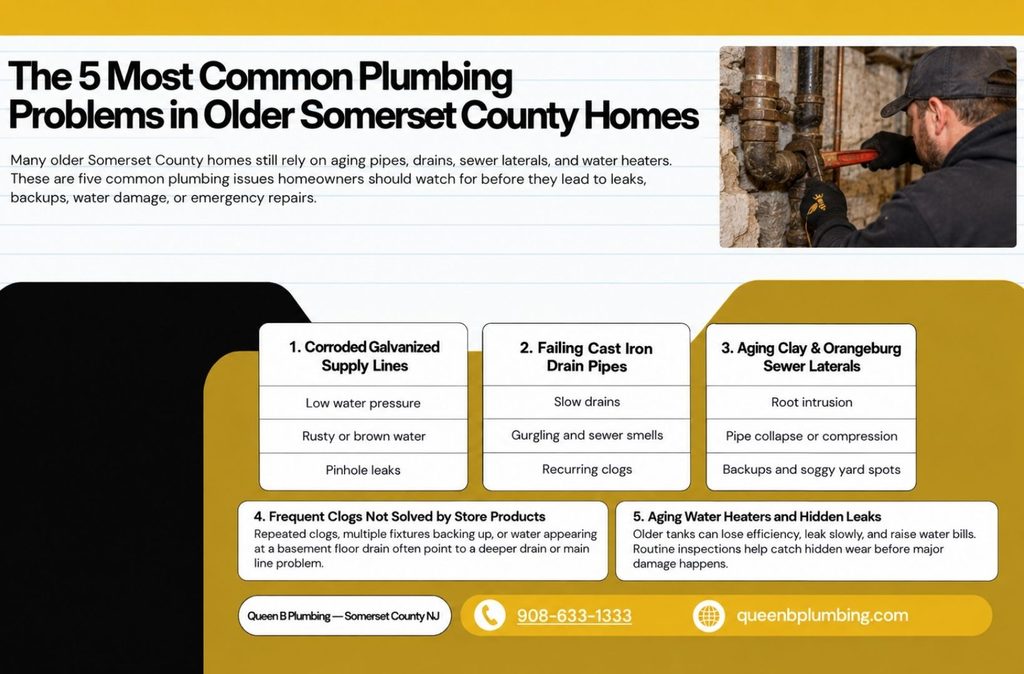
1. Corroded Galvanized Supply Lines (Low Pressure, Rusty Water)
Galvanized pipes in Somerset County homes were standard in construction before 1960, and decades later, many of those original lines are still in the walls. The zinc coating that once protected the steel wears away over time, and rust builds up on the inside of the pipe. This buildup narrows the interior diameter, which is why water pressure gradually drops even though nothing looks wrong from outside. By the time homeowners notice symptoms, the corrosion has usually been developing for years.
The clearest sign is brown or rusty water, especially the first draw of the day after water has sat in the pipes overnight. Weak pressure upstairs, compared to stronger flow on the ground floor, is another common complaint tied to galvanized lines. Frequent pinhole leaks are also typical, since corrosion eventually eats through the thinnest points in the pipe wall.
Galvanized supply lines have a design life of roughly 40 to 60 years, which means most installed before 1960 are now well past end-of-life. Repairs at this stage tend to be short-term fixes rather than real solutions. Homeowners with galvanized pipe should treat ongoing pressure or color issues as a signal to start planning for replacement, not just patching leaks as they appear.
2. Failing Cast Iron Drain Pipes (Slow Drains, Gurgling, Sewer Smells)
Cast iron was the standard choice for drain pipes from the 1930s through the 1970s, so it shows up throughout Somerset County’s older housing stock. The material is durable, with a realistic lifespan of 50 to 80-plus years, but it corrodes from the inside out over time. Horizontal runs are especially vulnerable, since scale and rust buildup settle along the bottom of the pipe rather than washing through evenly. As that buildup narrows the interior, drainage slows down long before any visible leak appears.
The most common symptom is slow drainage throughout the house, not just at one sink or tub. Gurgling noises from drains or toilets, along with occasional sewer odors, often point to a cast iron problem rather than a simple clog.
Recurring clogs are another red flag, particularly when standard snaking clears the blockage temporarily but it comes right back. This pattern usually means the pipe itself has narrowed or developed rough scale that keeps catching debris. Cracks and joint separation are also a risk with age, which can let roots or soil moisture into the line and worsen backups over time.
3. Aging Clay and Orangeburg Sewer Laterals (Roots, Collapses, Backups)
Sewer line repair in Somerset County NJ often traces back to mid-century homes that used clay tile or Orangeburg, a bituminous fiber pipe, for the lateral running from the house to the street connection. Both materials have a realistic service life of around 50 to 75 years, which puts many of them at or past that mark today. Clay pipe is jointed in short sections, and those joints are the weak point where problems typically start. Orangeburg, meanwhile, was never as durable to begin with and tends to fail from the inside as it ages.
Clay laterals most often fail through root intrusion, since tree roots seek out the moisture at pipe joints and grow into small gaps until they block or crack the line. Orangeburg pipe has a different failure mode: it can compress or collapse under the weight of the surrounding soil, especially after decades underground.
Both failure types show up as backups inside the home or soggy, sunken patches in the yard above the pipe’s path. This is especially relevant in older sections of Somerville, Bound Brook, Bernardsville, Warren, Watchung, and Bridgewater, where mature trees and clay-tile laterals frequently overlap. Homeowners in these neighborhoods should treat a sewer camera inspection as a priority, not an afterthought, given how common this combination is.
4. Frequent Clogs and Drainage Issues Not Solved by Store Products
Older drainage systems were designed for a very different household than the ones using them today. Garbage disposals, high-efficiency washing machines, and modern water usage patterns put more volume and debris through pipes that were never sized for that load. Over time, this mismatch accelerates buildup inside cast iron drains and aging sewer laterals. Store-bought drain cleaners rarely reach far enough into the system to address the real cause.
Repeated clogs, especially at the main line rather than a single fixture, are often a sign of something bigger than a simple blockage. Scaled cast iron or a compromised sewer lateral is the more likely culprit when the same clog keeps returning after cleaning.
A few warning signs point clearly toward a system-wide issue rather than an isolated one. Multiple fixtures backing up around the same time, water surfacing in a basement floor drain, and clogs that seem to move between different parts of the house are all signs the problem sits deeper in the drain or sewer line. When these patterns show up, a professional camera inspection is a more useful next step than another round of store-bought treatment.
5. Aging Water Heaters and Hidden Leaks
Most water heaters are built to last 10 to 15 years, but in older homes, it’s common to find units that have been running well past that mark.As a tank ages, sediment collects at the bottom and reduces efficiency, forcing the unit to work harder to heat the same amount of water. This buildup also stresses the tank itself, increasing the chance of a slow leak developing at a seam or fitting. By the time a leak becomes visible, the tank has often been declining in performance for a while.
Rising water bills or inconsistent hot water temperature are early signs that a water heater is nearing the end of its useful life. Waiting for a full tank failure usually means dealing with sudden water damage instead of a planned replacement.
Hidden leaks are a separate but related risk in older homes, since old fittings, connections, and even walls or slabs can hide slow leaks for years. Left unnoticed, this kind of leak leads to mold, wood rot, and steadily climbing water bills. Queen B recommends having heating services and plumbing inspected every two years, even without obvious problems, specifically to catch this kind of hidden wear before it becomes a larger repair
How to Tell What Kind of Pipes Your Older Home Has
Simple Visual and Magnet Checks
Figuring out what kind of pipe runs through your home doesn’t require any special tools, just a flashlight, a magnet, and a few minutes in the basement or crawlspace. Different pipe materials have distinct visual and physical traits that make them fairly easy to tell apart once you know what to look for. A magnet is especially useful, since it sticks to some metals but not others. Checking a few exposed sections near the water heater or main shutoff is usually enough to get a clear answer.
Galvanized steel has a dull silver-gray finish, and a magnet will stick firmly to it. A quick coin scratch on galvanized pipe reveals gray metal underneath, not the bright copper color you’d see on a copper line.
Copper pipe looks reddish-brown when newer or develops a green patina with age, and it is not magnetic. Scratching copper with a coin shows a bright, shiny metallic surface right away, which is an easy way to confirm the material.
Cast iron drain pipes are black or dark gray and noticeably heavy compared to other materials, and a magnet will stick to these as well. They’re often visible running along basement ceilings or through crawlspaces, making them one of the easier materials to spot without any tools at all.
PVC and ABS pipes are white or black plastic, lightweight, and non-magnetic, which makes them the easiest material to rule out. These are more common in sections that have already been updated, so finding them alongside older metal pipe usually means a partial repair happened at some point.
Match Pipe Types to Your Home’s Build Era
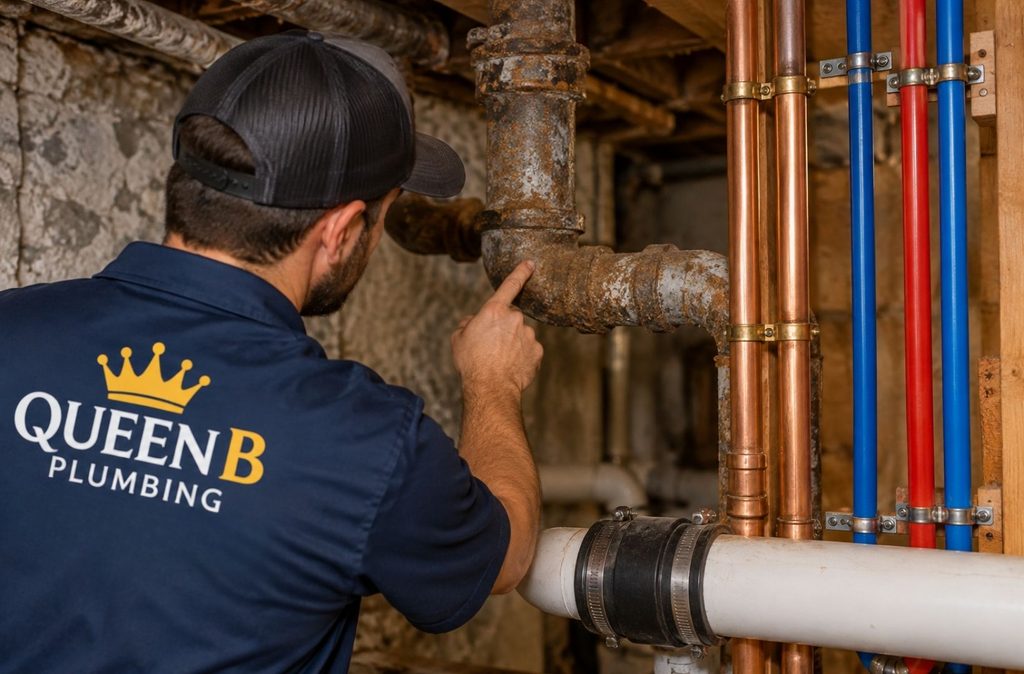
Once you know how to identify pipe materials, matching them to your home’s construction era gives you a much clearer picture of what to expect. Somerset County’s building booms happened in fairly distinct waves, and each one lines up with the plumbing materials that were standard at the time. This means you can often make a reasonable guess about your pipe types just by knowing when your home was built, even before checking anything in person. The table below breaks down what’s typical for each era, along with realistic lifespans and the first warning signs to watch for.
| Era Built | Likely Supply Pipe | Likely Drain/Sewer Pipe | Realistic Lifespan | First Warning Signs |
| Before 1960 | Galvanized steel | Cast iron drains, clay/Orangeburg sewer | 40–60 years (supply), 50–80+ years (drains) | Brown water, weak pressure, slow drains everywhere |
| 1960s–1980s | Copper (some galvanized main) | Cast iron, early PVC, clay sewer | 50+ years (copper), 50–75 years (cast iron/clay) | Localized leaks, recurring main line clogs |
| Post-1986 | Copper/PEX, no lead solder | PVC/ABS, some cast iron segments | 50+ years (copper/PEX) | Isolated fixture issues, water heater age more relevant |
If your home falls into the “before 1960” row and you’re still seeing original galvanized or cast iron pipe, it’s worth treating that as a planning point rather than waiting for a failure. Homes in the middle era often have a mix of materials from partial updates over the decades, so identifying pipe by section matters more than assuming one material throughout.
How Often Should Older Somerset County Homes Have Plumbing Inspected?
The general rule for any home is a professional plumbing inspection every one to two years, but that recommendation shifts once a home crosses certain age and material thresholds. Homes with galvanized or cast iron pipe, or homes over 30 years old, benefit from a more frequent schedule since those materials are already deep into their expected lifespan. Sticking to a set inspection cadence, rather than waiting for visible problems, is what catches small issues while they’re still inexpensive to fix. The right frequency really comes down to matching your home’s age and pipe materials to a realistic risk level.
Homes over 30 years old, or any home with galvanized or cast iron pipe, should be inspected yearly regardless of whether problems have shown up yet. Homes between 15 and 30 years old can typically move to a two-year cycle, since materials from that era still have meaningful life left.
Newer homes built in the last 10 to 15 years with PEX or copper can generally stretch to every two to three years between inspections. Sewer lines are the exception across all age groups: older clay pipe or any home with mature trees nearby should have the sewer line specifically checked every one to two years, separate from the general plumbing inspection.
Queen B’s standing recommendation reflects this same thinking: plumbing should be inspected every two years, even without any noticeable issues. For homeowners in Bridgewater, Warren, or elsewhere in Somerset County with an older home, scheduling that inspection now is the easiest way to stay ahead of the problems covered above.
Repair vs. Replace: When It’s Time to Repipe or Re-Drain
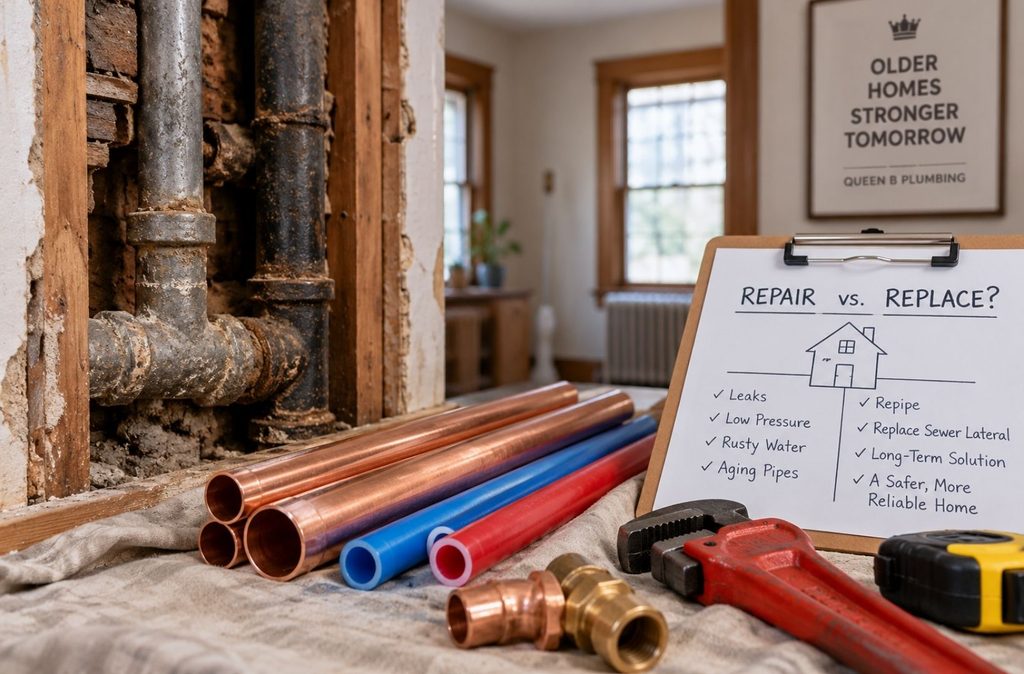
Signs You Need a Repipe in Somerset County
Signs you need a repipe in Somerset County aren’t always obvious, and not every plumbing issue means the whole plumbing services in Bridgewater, NJ need to come out. When problems show up in isolated spots, a targeted fix usually makes sense. When the same issues keep appearing throughout the house, that’s a sign the pipe material itself, not any one section, is the real problem.
Multiple pinhole leaks appearing in different areas of the home, rather than a single isolated spot, point to system-wide corrosion. Widespread corrosion, chronically low pressure throughout the house, and discolored water that doesn’t clear up even after running the tap are the clearest signals that patch repairs won’t hold.
Once a galvanized system passes the 50-year mark, individual repairs tend to become temporary fixes rather than real solutions. At that point, a full repipe with copper or PEX is typically more cost-effective over the long run than continuing to chase leaks one at a time.
Signs It’s Time to Re-Drain or Replace the Sewer Lateral
Sewer lateral problems tend to escalate quietly, since most of the pipe is buried and out of sight until symptoms show up inside the house. Recurring main line backups, especially ones that come back shortly after clearing, are usually the first clue that something more serious is happening underground. A camera inspection at that point can confirm whether the issue is isolated or something affecting the whole line.
A camera inspection showing heavy scale or cracking in cast iron, a collapsed section of Orangeburg, or severe root intrusion in clay pipe all point toward replacement rather than another round of clearing. These conditions tend to worsen steadily rather than stabilize on their own.
Cost & Disruption Considerations for Somerset County Homeowners
Repiping or replacing a sewer lateral understandably raises concerns about cost and how much disruption it will cause to daily life. Supply line replacement usually involves opening sections of wall to access the piping, while sewer lateral work often requires excavating part of the yard along the pipe’s path. Neither project is small, but understanding what’s involved ahead of time makes the process far less stressful. In many cases, the work can also be phased to reduce how much of the home is affected at once.
Phasing larger jobs, tackling one section or floor at a time, can help spread out both the cost and the disruption rather than taking on everything at once. This approach also allows homeowners to prioritize the areas with the most urgent wear first.
What a Professional Plumbing Inspection for an Older Home Includes
A thorough plumbing inspection covers far more than a quick look under the sink, especially in a home with decades-old materials. The goal is to build a full picture of the system’s condition, from visible pipe and fixtures down to pressure levels that can’t be seen at a glance. This kind of inspection, especially the 2-year plumbing inspection Queen B recommends, is what allows a plumber to catch small issues while they’re still easy to address. For older homes, it’s also the clearest way to get ahead of the kinds of problems covered earlier in this guide.
A standard inspection starts with a visual review of exposed pipes, fixtures, the water heater, and shut-off valves throughout the home. From there, the plumber typically runs pressure testing and leak detection, along with an assessment of pipe materials and any visible corrosion.
For homes with clay, Orangeburg, or cast iron sewer lines, a camera inspection is often available as an add-on to check for root intrusion or structural wear. This step is especially useful in neighborhoods with mature trees, where root-related issues are more likely.
Schedule Your Plumbing Inspection Today
Older homes have character worth preserving, and staying ahead of galvanized pipes, cast iron drains, and aging sewer laterals is how you protect that investment. Queen B Plumbing, Heating & Cooling makes it easy to plan ahead instead of reacting to an emergency.
Schedule your 2-year plumbing inspection today and get a clear, written picture of what your home’s plumbing needs now and in the years ahead. Our woman-owned team serves Warren, Hunterdon, Somerset, Morris, and Middlesex counties with 25 years of average technician experience and a 100% satisfaction guarantee.
If you’re already dealing with a leak, backup, or no hot water, don’t wait for the next inspection cycle. Call now for emergency plumbing repair, and we’ll get a technician out to assess the problem right away.


1 comment