
Hot-water recirculation system cost in NJ typically ranges from about $400 to $2,800 installed, although difficult retrofit projects can run higher. The final price depends mainly on whether your home already has a dedicated return line and which pump or control system you choose. Plumbing access and water heater compatibility also matter, especially if you have a tankless unit. These are planning ranges, not guaranteed Queen B Plumbing prices, so a plumber should inspect your system before giving you a firm quote.
This guide covers both simple retrofit pumps and full dedicated-loop systems so you can see where your home fits. It also explains what drives hot-water recirculation system cost in NJ before you call anyone for an estimate.
Homeowners across Warren and the surrounding Somerset, Hunterdon, Morris, and Middlesex county areas often ask about this upgrade. If you are tired of waiting for hot water, you can request a professional hot-water recirculation estimate at any point.
How much does a hot-water recirculation system cost in NJ?
Most New Jersey homeowners should budget about $400 to $2,800 installed. Retrofit crossover systems are usually the least expensive, demand-controlled systems cost more, and dedicated return-loop systems are often the most expensive because they may require new piping.
Hot-Water Recirculation System Cost in NJ at a Glance
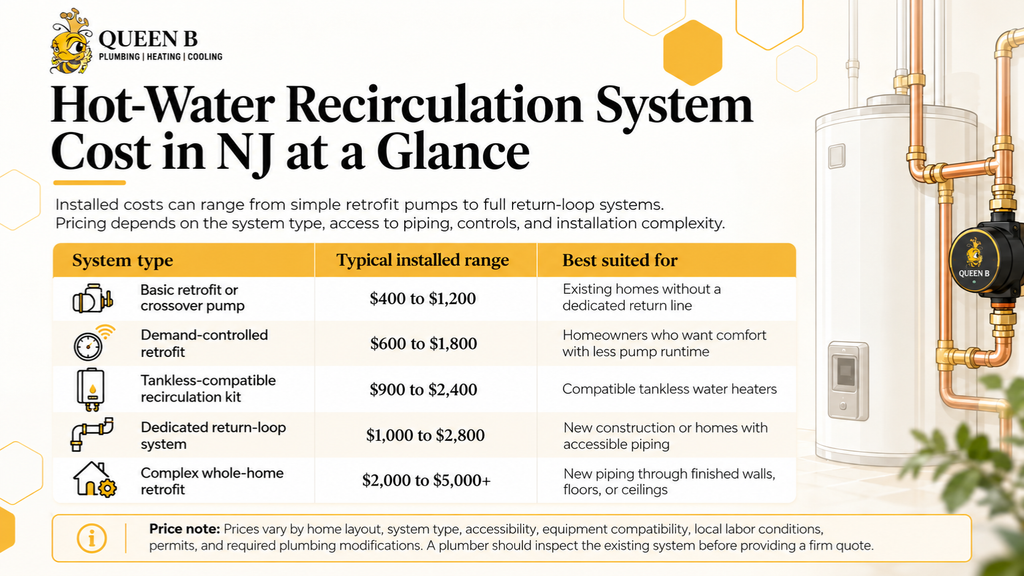
Recirculation pricing varies widely because the term covers everything from a small crossover pump to a full return loop. Simple retrofit systems are usually the least expensive since they can use your existing piping. Demand-controlled and tankless-compatible options cost more because of added controls and equipment requirements. Dedicated loops and complex retrofits sit at the top of the range because they may need new pipe routed through finished walls, floors, or ceilings.
| System type | Typical installed range | Best suited for |
| Basic retrofit or crossover pump | $400 to $1,200 | Existing homes without a dedicated return line |
| Demand-controlled retrofit | $600 to $1,800 | Homeowners who want comfort with less pump runtime |
| Tankless-compatible recirculation kit | $900 to $2,400 | Compatible tankless water heaters |
| Dedicated return-loop system | $1,000 to $2,800 | New construction or homes with accessible piping |
| Complex whole-home retrofit | $2,000 to $5,000+ | New piping through finished walls, floors, or ceilings |
Published estimates differ, with some sources placing basic pump installations below $1,000 and dedicated-loop retrofits at several thousand dollars when new pipe is needed. Recent cost references for crossover, demand, tankless-compatible, and dedicated-loop systems support the same general ranges.
The complex retrofit range reflects project difficulty, not a standard installation price. To see how labor is typically priced for other jobs, read our guide on how much a plumber costs in Warren, NJ.
Price note: Prices vary by home layout, system type, accessibility, equipment compatibility, local labor conditions, permits, and required plumbing modifications. A plumber should inspect the existing system before providing a firm quote.
What Is a Hot-Water Recirculation System?
In a standard plumbing setup, hot water only leaves the water heater when you open a tap. The water already sitting in the pipe cools down between uses, so you end up running the faucet until fresh hot water arrives. A hot-water recirculation system keeps that water moving so warm water stays closer to the fixture when you need it. The result is a shorter wait at distant sinks, showers, and tubs.
The U.S. Department of Energy describes recirculation as using a pump to cycle water through the plumbing loop between the water heater and the faucet. This reduces the amount of tepid water sent down the drain while you wait.
A recirculation system does not create unlimited hot water. You still need a properly sized water heater, and a plumber can confirm that when reviewing your home’s plumbing system.
Four terms come up often when you compare quotes. Knowing them makes estimates much easier to read.
- Recirculation pump: The mechanical pump that moves water through the hot-water line.
- Dedicated return line: A separate pipe that carries cooled water back to the water heater.
- Crossover valve: A valve that lets cooled water from the hot-water line return through the cold-water line when no dedicated return exists.
- Demand control: A button, sensor, timer, or smart control that runs the pump only when hot water is needed.
Which of these a home uses depends mostly on its existing piping layout. The next section breaks down hot-water recirculation system cost in NJ by system type.
Hot-Water Recirculation System Cost in NJ by System Type
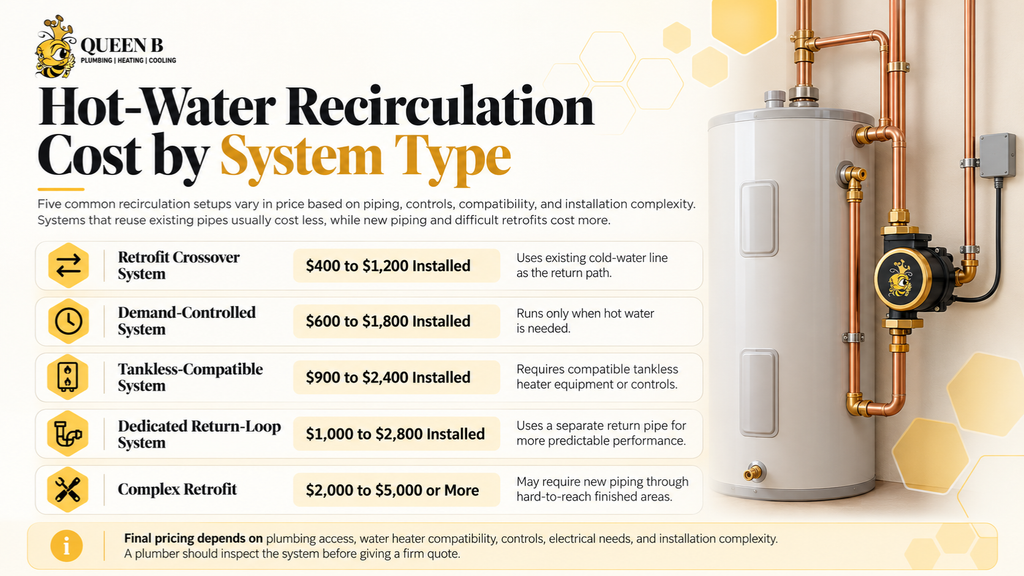
Recirculation systems fall into four main types, and each one is priced differently. The biggest difference is whether the system reuses existing pipes or needs new ones. Equipment, controls, and water heater compatibility add to the total from there. Here is what you can expect from each option, starting with the most affordable.
Retrofit Crossover System: $400 to $1,200 Installed
A retrofit crossover system is usually the least expensive way to speed up hot water in an existing home. It typically uses the cold-water line as the return path, so no new return pipe is needed. That means less labor, less disruption, and a lower price than a full loop. It is often a practical fit when opening walls is not realistic, which is common in older Somerset County homes with finished interiors.
This option works best when the layout and water heater setup are compatible. A plumber should confirm that before installation.
A few limitations are worth knowing:
- The cold-water line may briefly receive warmer water.
- The system must be designed and installed correctly.
- Some layouts or water heater configurations may not be suitable.
Demand-Controlled System: $600 to $1,800 Installed
A demand-controlled system runs the pump only when someone asks for hot water. The trigger can be a push button, motion sensor, temperature sensor, timer, or smart control. Limiting pump runtime helps reduce unnecessary circulation and heat loss from the pipes. This setup often suits homeowners who want faster hot water without a pump running all day.
Do not assume every demand system lowers your utility bills. Department of Energy research found that demand recirculation can reduce water waste but may not always produce energy savings.
Costs rise with more advanced controls. Insulation and proper settings also affect how well the system performs over time.
Tankless-Compatible System: $900 to $2,400 Installed
Some tankless water heaters include built-in recirculation features, while others need an external pump, a control kit, or a buffer tank. Compatibility depends on the heater brand, model, installation setup, and control method. A plumber may also need to verify flow requirements and follow the manufacturer’s instructions. If you are already weighing water heater repair or replacement options, it makes sense to ask about recirculation at the same time.
Not every tankless heater supports recirculation. Have the exact make and model ready when you request an estimate.
Equipment requirements are the main reason this category costs more than a basic crossover system.
Dedicated Return-Loop System: $1,000 to $2,800 Installed
A dedicated return-loop system uses a separate pipe that runs from the farthest fixture back to the water heater. It usually delivers the most predictable whole-home performance because water circulates through a purpose-built path. This design is common in new construction and major renovations, where pipes are easy to reach. It can also make sense during a bathroom renovation, when walls are already open.
In an existing home, the price climbs because the new pipe may need to pass through walls, ceilings, floors, or crawl spaces. Access work and repairs to finished surfaces can add significantly to the labor.
A dedicated loop is not automatically the best choice for every NJ home. A plumber should compare the expected comfort improvement with the access work and installation cost.
Complex Retrofit: $2,000 to $5,000 or More
This range applies only to projects with added difficulty, not to standard installations. It covers homes where new piping has to be routed through hard-to-reach areas or where several trades are involved. In some cases, aging pipes also need attention, and a guide on when to replace plumbing pipes can help you judge whether that applies to you. Treat this figure as a project-complexity range rather than a typical price.
Projects in this range often involve:
- Multiple floors or long distances between the water heater and fixtures.
- Finished walls or ceilings.
- Limited crawl space or basement access.
- Multiple branches or bathrooms.
- Electrical work or a new outlet.
- Pipe replacement, insulation, shutoff valves, or water heater modifications.
- Difficult tankless integration.
What Affects Hot-Water Recirculation System Cost in NJ?
Two homes in the same town can receive very different quotes for the same upgrade. The difference usually comes down to how the existing plumbing is built and how easy it is to reach. Equipment choices and water heater type also change the total. The factors below explain where most of the price variation comes from.
Existing Plumbing Layout
The farther a fixture is from the water heater, the more work a recirculation system has to do. Long pipe runs, multiple floors, and several branches all make the design more involved. A plumber may need to size the pump differently or add components to serve every bathroom and kitchen. Each added branch can raise both the equipment cost and the labor time.
Flow rate matters here too. If your home already has low water pressure, mention it during the estimate so the plumber can account for it.
Dedicated Return Line Versus Crossover Valve
This is often the single biggest cost decision. A crossover system can avoid new return piping, which keeps labor low. A dedicated loop requires a new pipe path, which can mean substantial work in an existing home. The right choice depends on your layout and how much disruption you are willing to accept.
Neither option is automatically better. A plumber can weigh comfort, cost, and access before recommending one.
Access to Pipes
Easy access keeps labor costs down. Basement ceilings, utility rooms, crawl spaces, and unfinished areas let a plumber work without opening finished surfaces. Tile, plaster, flooring, and multiple stories do the opposite and add time. Homes with limited access can also require patching and repair work after the installation.
Hidden plumbing problems can surface when walls are opened. A plumbing inspection checklist can help you spot concerns before the project starts.
Pump and Control Features
Basic pumps cost less than systems with advanced controls. Features that add to the price include:
- Demand activation.
- Motion sensors.
- Smart controls.
- Programmable timers.
- Temperature sensors.
- Variable-speed pumps.
- Manufacturer-specific tankless controls.
Better controls can limit pump runtime and improve comfort. They also raise the upfront cost.
Water Heater Type
Your water heater affects both the equipment you need and the installation steps. A standard tank heater is usually the simplest to work with, while tankless units often require specific accessories. The setup can also differ for a gas tankless heater, an electric tankless heater, a solar-assisted or hybrid system, or a boiler with an indirect tank. If your home runs on a boiler, it helps to understand your boiler services and how the system is configured.
Your plumber should check the manufacturer’s instructions for your exact model. Your overall heating services setup may also influence the best approach.
Electrical Requirements
Many recirculation pumps need power, and some controls need a dedicated connection. Depending on the home, an installation may require:
- A nearby receptacle.
- A dedicated control connection.
- Electrical modifications.
- GFCI protection where applicable.
- Coordination with an electrician.
Electrical needs vary by site, so they are not included in standard price ranges. Your plumber can tell you what applies to your home.
Pipe Insulation
Insulating hot-water lines reduces heat loss as water circulates. It also helps the pipes hold warmth between uses. Insulation is a design consideration, not a guarantee of savings, and it adds a small amount to material costs. Insulated pipes in cold areas also benefit from the same protection described in this guide to frozen pipe prevention.
Good insulation works best alongside demand controls. Together they limit wasted energy.
Permits and Local Requirements
Permit rules vary by municipality and project scope. New Jersey’s current plumbing subcode references the National Standard Plumbing Code/2024, New Jersey edition, adopted August 17, 2026. Permit and inspection fees, when required, are added to the project cost. Your plumber or local construction office can confirm what applies before work begins.
Not every recirculation installation requires a permit. Ask your plumber to state their permit assumptions in the estimate.
Hot-Water Recirculation System Cost in NJ: Estimated Breakdown
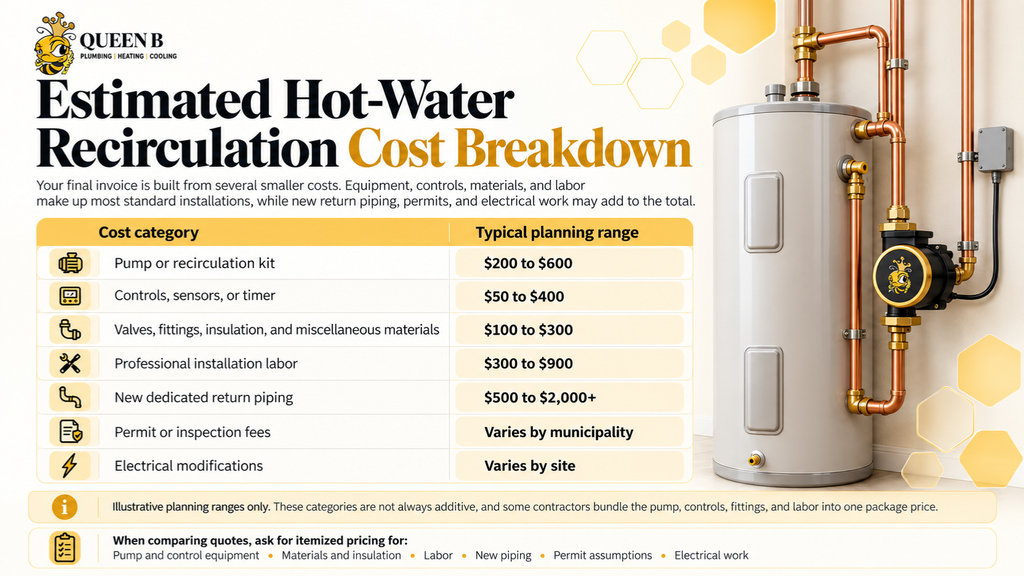
Your final invoice is built from several smaller costs, and knowing them helps you compare quotes fairly. Equipment, controls, materials, and labor make up most of a standard installation. New return piping, permits, and electrical work are added only when your home needs them. The table below shows illustrative planning ranges, not guaranteed prices.
| Cost category | Typical planning range |
| Pump or recirculation kit | $200 to $600 |
| Controls, sensors, or timer | $50 to $400 |
| Valves, fittings, insulation, and miscellaneous materials | $100 to $300 |
| Professional installation labor | $300 to $900 |
| New dedicated return piping | $500 to $2,000+ |
| Permit or inspection fees | Varies by municipality |
| Electrical modifications | Varies by site |
These categories are not always additive. Some contractors bundle the pump, controls, fittings, and labor into a single package price.
One recent New Jersey estimate places equipment at about $250 to $600, labor at about $300 to $900, and permits and materials at about $100 to $200 for many residential installations. Treat this as a secondary benchmark, not a Queen B Plumbing price list.
When you compare quotes, ask each plumber to itemize the following:
- Pump and control equipment.
- Materials and insulation.
- Labor hours or flat labor charge.
- New piping, if any.
- Permit and inspection assumptions.
- Electrical work, if needed.
If the total is higher than you planned, look into financing options for home upgrades. You can also check the savings page for current offers before you book.
Is a Hot-Water Recirculation System Worth It?
Whether this upgrade pays off depends on your home and how your household uses hot water. For some families it removes a daily frustration, and for others the hot-water recirculation system cost in NJ is hard to justify. The strongest and most predictable gains are convenience and less wasted water. The EPA notes that recirculating systems can reduce water wasted while waiting for hot water, and that demand-initiated controls can be more energy-efficient than continuous timer or temperature-based circulation.
When It May Be Worth Considering
A recirculation system tends to make sense when waiting for hot water is a regular annoyance. Look for these signs:
- A bathroom or kitchen takes a long time to receive hot water.
- The water heater is far from your main fixtures.
- Your household wastes a lot of water waiting for hot water.
- Several people use distant fixtures throughout the day.
- You value convenience and quick hot water.
- Your plumbing is accessible enough for a return line.
- The system can run on demand instead of all day.
If most of these apply, the upgrade is worth pricing out. You can look through past plumbing projects to see the kind of work the team handles.
When It May Be Less Attractive
Recirculation is not a fit for every home. It may not be worth the cost in these situations:
- The wait for hot water is only a few seconds.
- The water heater is already close to your fixtures.
- Installation would require heavy wall or floor demolition.
- The pump would run nonstop without proper controls or insulation.
- You expect it to reduce your overall water heating costs.
That last point is a common misunderstanding. A recirculation system can lower water waste without lowering your energy bill.
A simple way to decide is to compare the daily frustration you feel now against the installed price for your home. If the wait is minor and the work is invasive, a simpler fix may serve you better.
Does a Hot-Water Recirculation System Save Water or Energy?
A recirculation system can save water, but it does not automatically save energy. The two outcomes work differently, and mixing them up leads to unrealistic expectations. Water savings come from not running the tap while you wait for hot water. Energy use depends on how often the pump runs and how well the pipes hold heat.
Water Savings
Recirculation can reduce the amount of cooled water that goes down the drain while you wait. EPA materials cite an average household water-waste estimate of more than 10,000 gallons per year while waiting for hot water. That is a broad national estimate, not a guaranteed savings figure for a New Jersey household.
Your actual savings depend on several things:
- Pipe length and diameter.
- Number of daily uses.
- Household size.
- Fixture flow rate.
- How long you normally wait for hot water.
- Whether the system is balanced and controlled properly.
A home with a long wait and heavy daily use has the most to gain. A home with a short wait may see little difference.
Energy Use
A recirculation pump uses electricity, and hot water moving through pipes loses heat along the way. Continuous circulation can raise energy use, especially when the system is poorly set up. This is more likely when:
- The pipes are poorly insulated.
- The system circulates when nobody needs hot water.
- The return loop is too long.
- The pump is the wrong size.
- The controls are not configured properly.
Demand controls, timers, and good insulation help limit that extra runtime. If you are also planning a larger heating upgrade, such as an oil to gas conversion, ask your plumber to review the hot-water setup at the same time.
The system’s strongest predictable benefit is convenience and reduced water waste. Energy savings are possible with demand controls, insulation, and correct design, but homeowners should not assume that every recirculation system lowers utility bills.
How to Get an Accurate Estimate for Hot-Water Recirculation System Cost in NJ
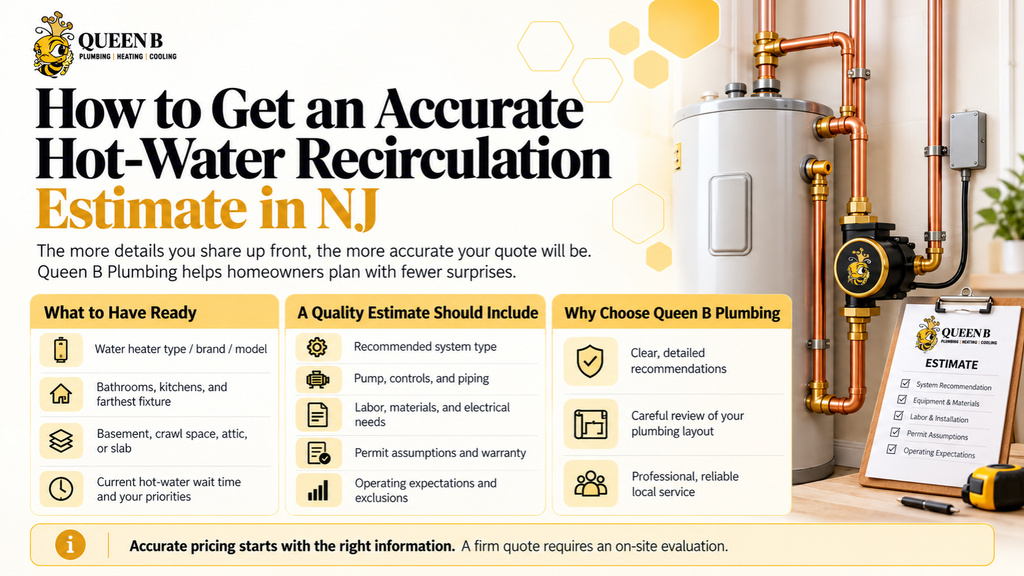
A quote is only as accurate as the information your plumber has about your home. Recirculation projects depend on your water heater, your pipe layout, and how easy the plumbing is to reach. If you share the right details up front, the estimate will be closer to the final price and fewer surprises will come up on install day. Gathering a few basics before you call also saves time during the inspection.
What to Have Ready
Pull together these details before you request an estimate:
- Water heater type, brand, and model.
- Number of bathrooms and kitchens.
- Approximate distance to the farthest fixture.
- Whether your home has a basement, crawl space, attic, or slab foundation.
- Whether the walls and ceilings are finished.
- How long hot water currently takes to arrive.
- Whether you care most about the lowest upfront cost, the fastest delivery, lower operating cost, or smart controls.
A photo of your water heater label is especially helpful for tankless units. It lets the plumber check manufacturer compatibility before the visit.
What a Quality Estimate Should Include
A good estimate spells out exactly what you are paying for. It should identify these items:
- The recommended system type.
- Pump and control equipment.
- Required piping.
- Labor and materials.
- Electrical needs.
- Permit assumptions.
- Warranty details.
- How the system is expected to operate.
- Any exclusions or restoration work.
If an estimate leaves out several of these, ask the plumber to fill in the gaps. Vague quotes are the most common source of surprise charges later.
Choosing a Plumber You Can Trust
Pricing matters, but so does the track record of the company doing the work. Reading what past customers say about Queen B Plumbing is a good way to gauge service quality before you book.
Remember that a firm price requires an on-site evaluation. Any quote given without seeing your plumbing should be treated as a rough range.


