Somerset County homeowners should consider replacing their plumbing pipes when leaks keep recurring, corrosion is widespread, water pressure continues to decline, water appears rusty or discolored, or an inspection shows that the piping system is nearing failure. The age and material of the pipes matter, but symptoms and inspection findings are more useful than age alone. A licensed plumber can determine whether the home needs a localized repair, partial replacement, or whole-house repiping. Knowing when to replace plumbing pipes can save homeowners from costly emergency repairs and severe water damage down the line. You can learn more about these comprehensive solutions by exploring our professional Plumbing Services in Somerset County, NJ.
Many Somerset County homes vary considerably in age and construction, from mid-century developments to newer builds with updated materials. That range means a single age cutoff cannot reliably predict when a home’s plumbing needs attention. The pipe material, installation history, and current condition should be evaluated on their own terms rather than assumed from the year a house was built.
Repair or Replace? Start With the Scope of the Problem
Not every plumbing issue points toward a full replacement, and not every leak is a sign of a healthy system either. The right response depends on whether the problem is isolated to one section of pipe or reflects a broader pattern across the home. Understanding that distinction early helps homeowners avoid both unnecessary repiping and repeated repairs on a system that is quietly failing.
A repair may be appropriate when:
- The leak is isolated.
- The surrounding pipe is in good condition.
- There is no evidence of widespread corrosion.
- Water pressure and water quality are normal.
- The pipe material is otherwise performing reliably.
- The failure was caused by a damaged fitting, valve, or connection rather than deteriorating pipe.
Replacement may be more appropriate when:
- Leaks occur in multiple areas.
- The same section repeatedly fails.
- Corrosion is visible on multiple exposed pipes.
- Water pressure is low throughout the house.
- Water is consistently rusty, brown, yellow, or metallic-tasting.
- Repairs are becoming frequent or disruptive.
- An inspection identifies extensive deterioration.
- The piping is made from a material known to be unsuitable, severely degraded, or affected by lead concerns.
One isolated failure does not automatically mean a home needs repiping. A pattern of failures usually deserves a broader plumbing inspection.
8 Signs Your Plumbing Pipes May Need Replacement
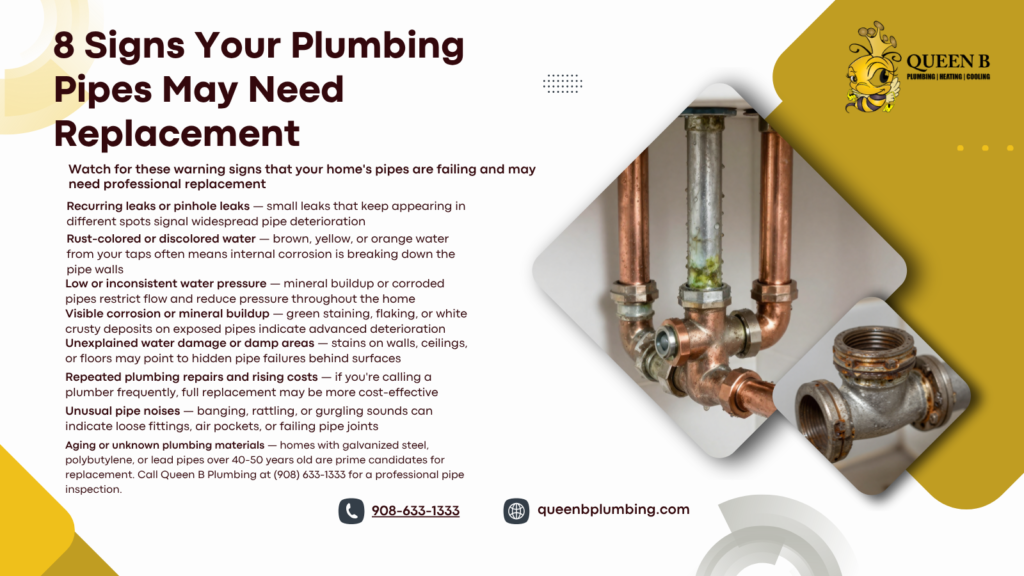
Some plumbing problems are minor and easy to dismiss, while others are early warnings of a system in decline. The signs below don’t automatically mean a home needs whole-house repiping, but they are worth taking seriously, especially when more than one shows up at the same time. A licensed plumber can help sort out which signs point to a simple fix and which point to something bigger.
1. Recurring leaks or pinhole leaks
A single leak can happen for all kinds of reasons and often doesn’t say much about the rest of the plumbing system. Repeated leaks in different locations, however, may point to systemic deterioration rather than a string of unrelated bad luck. Pinhole leaks are especially worth watching in older copper piping, since they tend to recur along the same plumbing runs once corrosion sets in.
There is no set number of leaks that automatically means a home needs repiping. When leaks are recurring or showing up in multiple areas, that pattern is a good reason to bring in a plumber for a full evaluation.
2. Rust-colored, brown, or discolored water
Discolored water can be alarming, but it doesn’t always mean the interior pipes are failing. Internal corrosion is one possible cause, but disturbed sediment, nearby water-main work, or an issue limited to a single fixture or service line can produce the same symptom.
A few simple checks can help narrow things down. Run the cold water briefly to see whether the color clears, and check whether the discoloration affects one fixture or the whole home. For issues tied more directly to heating appliances, you can look over professional Bridgewater Water Heater Repair guidelines.
Discolored water alone doesn’t prove that all interior pipes must be replaced. If the issue persists or keeps coming back, contact the water provider or a plumber for a closer look.
3. Low or inconsistent water pressure and when to replace plumbing pipes
Weak water pressure is a common complaint, but it can stem from several different causes. Corroded or narrowed supply pipes are one possibility, along with a failing pressure-reducing valve, a partially closed shutoff valve, a clogged fixture aerator, a water-main or service-line issue, or simply high simultaneous demand in the home.
Where the pressure drop shows up can help point to the cause. If only one fixture is affected, the cause is likely local; if multiple fixtures are affected, the issue may involve the home’s supply piping or main water line. Sometimes, sudden pressure drops or delivery problems are also tied to failing equipment like an aging water heater or issues addressed during standard New Jersey HVAC Contractor service calls.
4. Visible corrosion, staining, or mineral buildup
Corrosion often shows up in the places homeowners rarely look, like basements, crawl spaces, utility rooms, and under sinks. Common examples include green or blue-green staining around copper fittings, orange or brown rust on galvanized steel, flaking or pitting, dampness around joints, and mineral deposits near connections.
Visible corrosion is a useful clue, but it only tells part of the story. It doesn’t reveal the condition of pipes hidden behind walls or under floors, so a full inspection is needed to assess the broader system.
5. Unexplained water damage or recurring damp areas
Ceiling stains, wall damage, swollen flooring, musty odors, and damp cabinetry are all signs that water is going somewhere it shouldn’t. The tricky part is that the visible damage often appears far from where the actual leak is occurring, which can make the source hard to pinpoint without professional help.
If a pipe is actively leaking, shut off the nearest valve or the home’s main water supply if it’s safe to do so. You can also review general safety and emergency procedures outlined by a trusted local New Jersey HVAC Contractor. Arrange prompt professional service right away to limit further damage.
6. Repeated plumbing repairs and rising costs
Paying for the same type of repair over and over can add up quickly, both in cost and in disruption to the household. At some point, it’s worth comparing the long-term cost of repeated repairs against the cost of a planned replacement.
Repiping won’t always save money, and no article can promise that it will. An inspection and a written estimate give homeowners the information they need to compare their options directly.
7. Unusual pipe noises
Banging, knocking, whistling, or vibrating pipes tend to get a homeowner’s attention fast. These sounds can result from water hammer, loose pipe supports, pressure problems, faulty valves, or restricted flow somewhere in the system.
Noise on its own isn’t proof that pipes need to be replaced. It becomes more concerning when it shows up alongside other signs, like leaks or low water pressure.
8. Aging or unknown plumbing materials that dictate when to replace plumbing pipes
Not every homeowner knows what their plumbing is actually made of, and that’s worth finding out. This includes the interior water supply pipes, the pipe entering the home from the street, the drain and sewer piping, and any sections that have been repaired in the past.
Generic pipe-life estimates can be a useful starting point, but they shouldn’t be treated as guarantees. Actual service life depends on water chemistry, installation quality, water pressure, soil conditions, maintenance, and prior repairs. Homeowners interested in broader material standards can review guidelines provided by organizations like the EPA on Lead in Drinking Water when evaluating older service lines.
Which Plumbing Pipes Are Commonly Replaced?
Different pipe materials tend to fail in different ways, and knowing what’s common for each type can help homeowners understand what a plumber is looking for during an inspection. The table below breaks down the most common materials found in Somerset County homes, along with the concerns typically associated with each. It’s meant as a general reference, not a diagnosis for any specific property.
| Pipe or system | Common concerns | Replacement discussion |
| Copper | Pinhole leaks, pitting, corrosion, repeated failures | Localized repairs may work when damage is isolated; recurring failures may justify partial or whole-home replacement. |
| Galvanized steel | Internal rust, restricted flow, discoloration, deteriorating threaded connections | Extensive internal corrosion or widespread low pressure may support replacement. |
| PEX | Fitting failures, improper installation, damage from unsuitable conditions | Replacement depends on the specific product, installation, and observed failure pattern. |
| Lead or galvanized service lines | Potential drinking-water concerns and regulatory requirements | Identify the line material and coordinate with the local water provider and a qualified professional. |
| Cast iron drains | Cracks, corrosion, root intrusion, collapses, recurring backups | Drain or sewer replacement is evaluated separately from interior water-supply repiping. |
| PVC or other plastic piping | Cracks, failed joints, damage, or installation issues | Replacement is generally based on condition and failure rather than age alone. |
It’s easy to lump all plumbing pipes together, but interior pipes, the exterior water service line, and the sewer lateral are different systems entirely. To see the full suite of solutions available for your household, visit our primary Plumbing Services in Somerset County, NJ. They can involve different owners, permits, and inspection requirements, so a problem with one doesn’t necessarily mean the others are affected.
How a Plumber Determines Whether Replacement Is Necessary
Deciding between a repair and a replacement isn’t a guess, and a qualified plumber follows a fairly consistent process to reach that decision. The evaluation looks at the home’s plumbing history, the physical condition of accessible pipes, and how the system is performing day to day. Understanding when to replace plumbing pipes requires a professional evaluation that walks through a consistent diagnostic process. Walking through that process can help homeowners understand what to expect during an inspection and why the recommendation comes out the way it does.
- Review the home’s history. The plumber will ask about construction date, previous repiping, recent renovations, leak frequency, water pressure, water discoloration, and repair records. They may also check whether other home systems—such as your Tankless Vs Hybrid Water Heaters—are interacting poorly with fluctuating home water pressures.
- Inspect accessible pipes. This includes looking for corrosion, staining, damaged fittings, moisture, and incompatible materials in basements, crawl spaces, and utility areas.
- Test water pressure. Readings are compared at multiple fixtures to determine whether an issue is localized or system-wide.
- Check for active or hidden leaks. The plumber may assess the meter, exposed piping, fixtures, walls, ceilings, crawl spaces, or other accessible areas.
- Identify pipe materials. Interior supply lines, the service-line entry point, and drain materials are documented where accessible.
- Evaluate the scope. The plumber determines whether the best option is a repair, a branch-line replacement, a main-line replacement, partial repiping, or whole-home repiping.
- Explain access and restoration. This covers wall or floor access, fixture removal, permits, shutoff duration, patching, and cleanup.
- Provide a written estimate. A clear estimate separates labor, materials, access, permits, restoration, and any optional upgrades.
A plumbing inspection should ultimately answer three questions: Where is the failure? Is the surrounding piping also deteriorating? Which replacement scope solves the problem without replacing more pipe than necessary?
How Much Does Pipe Replacement Cost?
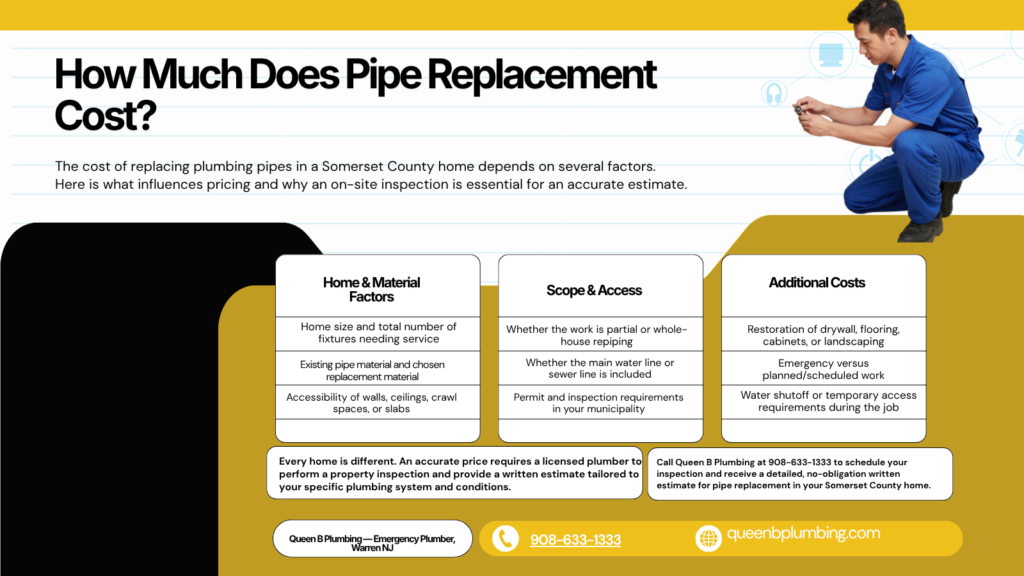
Cost is often the first question homeowners want answered, but it’s also the hardest one to answer responsibly without seeing the actual property. Pipe replacement pricing depends on a wide range of factors that vary from one home to the next, which is why this section focuses on what drives the price rather than a specific number.
The price of a pipe replacement project depends on:
- Home size and number of fixtures.
- Pipe material and replacement material.
- Accessibility of walls, ceilings, crawl spaces, and slabs.
- Whether the work is partial or whole-house.
- Whether the main water line or sewer line is included.
- Permit and inspection requirements.
- Restoration of drywall, flooring, cabinets, or landscaping.
- Emergency versus planned work.
- Water shutoff and temporary access requirements.
Given all of these variables, it’s not realistic to expect an accurate number without an inspection. A plumber cannot responsibly quote a meaningful repiping price from symptoms alone. The scope should be based on an inspection and a written estimate that explains what will be replaced, what will remain, how long the water may be off, and whether restoration is included.
Get a Professional Opinion on Your Somerset County Home’s Plumbing
Recurring leaks, rusty water, and low pressure aren’t things homeowners need to figure out on their own. A licensed plumber can look past the surface-level symptoms and determine what’s actually happening inside the walls, under the slab, or along the service line. Consulting a professional is the best way to figure out precisely when to replace plumbing pipes versus opting for a simple patch job. That evaluation is what separates a homeowner guessing at a fix from one making an informed decision about their plumbing system.
Seeing recurring leaks, rusty water, or low pressure throughout your home? Contact Queen B Plumbing, Heating & Cooling to discuss an inspection and determine whether you need a repair, partial replacement, or broader repiping plan. Contact Queen B Plumbing, Heating & Cooling to discuss an inspection and determine whether you need a repair, partial replacement, or broader repiping plan.


1 comment