Buying a home in New Jersey means more than checking the roof and the foundation, since plumbing problems can hide behind walls and under floors until it’s too late. A New Jersey homebuyer’s plumbing inspection should cover visible supply and drain pipes, water pressure, faucets, toilets, drains, water heaters, shutoff valves, sump pumps, basement plumbing, exterior hose bibs, and visible signs of leaks or water damage. For older homes or properties with suspected sewer, septic, well, or concealed-pipe problems, consider a separate inspection by a licensed plumber. New Jersey defines a home inspection as a visual, non-invasive review of readily accessible components, which is why some plumbing issues can go undetected. This plumbing inspection checklist walks through exactly what to look for before you close.
Why Plumbing Matters Before Closing
A home can look completely move-in ready while quietly hiding leaks, poor drainage, deteriorated piping, or an aging water heater that’s closer to failure than it appears. These issues rarely stay small, since plumbing failures can damage walls, ceilings, flooring, and even finished basements if they go unnoticed long enough. A clear checklist helps buyers tell the difference between routine maintenance and the kind of problem that could affect negotiations or the decision to move forward. That said, this checklist is not a substitute for a licensed inspection or an official code determination, and some findings will always require a professional’s judgment.
Timing matters just as much as thoroughness when it comes to plumbing issues. The earlier a buyer identifies a problem, the more options they generally have to request repairs, negotiate a credit, order additional testing, or reconsider the purchase altogether.
No checklist, however detailed, can promise that every plumbing defect will surface during a standard walkthrough. Some problems are concealed behind walls, buried underground, or tied to systems like septic or well setups that require specialized evaluation.
Quick Plumbing Inspection Checklist for Homebuyers
Before diving into every system and component in detail, it helps to have a fast, scannable checklist you can use during a walkthrough or while reviewing an inspection report. This section pulls together the most important items across interior fixtures, the water heater, basement and utility areas, exterior plumbing, and sewer, septic, or well considerations. Think of this plumbing inspection checklist as your first pass, the kind of thing you can run through in twenty minutes without any special tools. Once you’ve flagged anything unusual, you’ll know where to focus a closer look or bring in a professional.
Interior Plumbing
Interior fixtures are usually the easiest place to start, since most are visible and accessible without moving anything. A few minutes at each sink, tub, and toilet can reveal a surprising amount about the home’s overall plumbing condition.
- Test every accessible faucet for flow, temperature, leaks, and unusual discoloration.
- Flush every toilet and check for rocking, slow refill, running water, or leaks at the base.
- Run sinks, tubs, and showers and observe drainage speed.
- Look under cabinets for moisture, corrosion, staining, or patched materials.
- Check exposed supply lines, drainpipes, traps, and shutoff valves.
- Listen for banging, whistling, gurgling, or persistent running water.
- Look for water stains, peeling paint, warped flooring, musty odors, and visible mold-like growth.
- Check whether fixtures can be isolated using accessible shutoff valves.
If any of these checks turn up something questionable, Queen B’s plumbing services in Warren, NJ cover everything from leak repair to full pipe replacement.
Water Heater
The water heater is one of the more expensive components a buyer will inherit, so it deserves closer attention than a quick glance. Age, visible condition, and documentation all matter here, and none of them require touching anything you shouldn’t. New Jersey’s home-inspection standards include domestic water-heating systems but exclude operating safety valves or automatic safety controls, so this is an area where looking carefully counts more than testing. The goal is to gather enough information to know whether a professional evaluation is worth requesting before closing.
- Record the manufacturer, model, fuel type, and approximate age.
- Look for rust, corrosion, leakage, sediment, or damage around the tank.
- Check visible supply, discharge, gas, and electrical connections.
- Confirm that the temperature-and-pressure relief discharge pipe is present and correctly routed based on professional evaluation.
- Ask whether installation permits and service records are available.
- Do not operate safety valves or controls as a DIY test.
A professional evaluation from a team offering water heater repair and replacement can confirm whether the unit is nearing the end of its service life.
Basement, Crawl Space, and Utility Areas
Basements and crawl spaces tend to reveal more about a home’s plumbing history than any other area, since this is usually where pipes run exposed and problems leave visible traces. Moisture, staining, and odd smells here often point to issues that have been developing for months or years before a buyer ever sees the house. Sump pumps deserve particular attention in New Jersey, where basement flooding is a common concern during heavy rain. A careful walk-through of these spaces can surface warning signs that interior fixtures alone won’t show.
- Inspect exposed pipes for leaks, corrosion, insulation damage, or improvised repairs.
- Look for standing water, efflorescence, staining, damp odors, and water marks.
- Test the sump pump only when it is safe and practical to do so.
- Check whether the sump discharge directs water away from the foundation.
- Note backup pumps, battery systems, alarms, and discharge-line conditions.
- Look for sewage ejector pumps and accessible cleanouts where applicable.
- Identify low areas where a leak could remain hidden
If the sump system looks questionable, it’s worth having someone check it before closing, since sump pump repair and replacement is one of the most common basement-related calls Queen B receives..
Exterior Plumbing
Exterior plumbing is easy to overlook during a walkthrough, especially since most buyers focus their attention indoors. But hose bibs, drainage patterns, and unexplained wet spots around the yard can point to leaks or foundation issues that start outside and work their way in. New Jersey’s freeze-thaw cycles make exterior fixtures especially prone to cracking or failure over time. A few extra minutes outside can catch problems that never show up during an interior inspection.
- Test accessible hose bibs for leaks and proper shutoff.
- Check for dripping, freezing damage, cracked fixtures, or missing vacuum breakers where applicable.
- Look for unexplained wet areas, unusually lush vegetation, sinkholes, or wastewater odors.
- Check whether downspouts and sump discharge are contributing to foundation moisture.
- Do not confuse stormwater drainage with sanitary sewer plumbing.
Sewer, Septic, and Well Considerations
Sewer, septic, and well systems sit outside the scope of what a standard visual walkthrough can meaningfully evaluate, since most of the relevant components are buried or otherwise inaccessible. These systems also carry some of the highest repair costs a homebuyer can face, which makes asking the right questions upfront especially important. Older homes, properties with mature trees near the sewer route, or homes with a history of backups all warrant extra caution. The goal at this stage is simply to know what to ask and when to bring in a specialist.
- Ask whether the property connects to municipal sewer or uses a septic system.
- Ask when the sewer lateral was last inspected or cleaned.
- Consider a camera inspection for older homes, large trees near the sewer route, recurring backups, or uncertain pipe materials.
- For septic properties, request available records and arrange an inspection by an appropriate septic professional.
- For private wells, treat water quantity, water quality, well equipment, and plumbing as related but distinct evaluations.
A standard visual home inspection should not be assumed to include sewer-camera inspection, septic certification, well testing, or water-quality analysis. Those are separate services that typically require their own scope and their own professionals.
Room-by-Room Inspection Checklist
Sometimes it’s easier to work through a home space by space rather than system by system, especially during an actual walkthrough when you’re moving from room to room anyway. The table below organizes the same core checks into a room-by-room format, pairing what to look at with the specific warning signs that should catch your attention. It’s meant to work alongside the plumbing inspection checklist above, not replace it, giving you a second way to stay organized on-site. . Keep it handy on your phone or printed out during the showing.
| Area | What to check | Warning signs |
| Kitchen | Faucet, sprayer, disposal, dishwasher supply and drain connections, cabinet base | Moisture, odor, slow drain, corrosion |
| Bathrooms | Faucets, showers, tubs, toilets, caulk, accessible valves | Low flow, rocking toilet, stains, running toilet |
| Laundry room | Washer hoses, standpipe, drain, utility sink, floor drain | Bulging hose, overflow marks, leaks |
| Basement | Main water entry, exposed pipes, water heater, sump system, ejector pump | Rust, dampness, standing water, patched piping |
| Crawl space | Supply and drain lines, insulation, supports, moisture | Sagging lines, condensation, mold-like odors |
| Exterior | Hose bibs, visible cleanouts, drainage near foundation | Leaks, standing water, unexplained wet ground |
| Garage | Water heater, utility sink, exposed piping, floor drains | Corrosion, unsafe installation indicators, leakage |
Plumbing Systems and Components to Evaluate
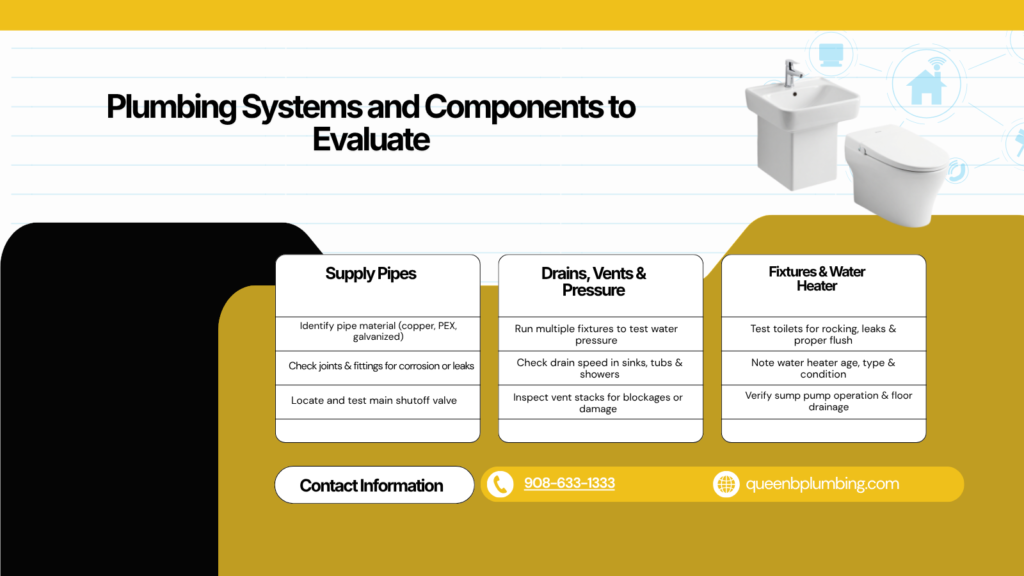
Beyond a quick walkthrough, it helps to understand the major systems that make up a home’s plumbing so you know what questions to ask and what a professional might be looking for. Each system carries its own set of age-related risks, common failure points, and cost implications if something needs repair or replacement. This section breaks down supply pipes, drains and vents, water pressure, toilets and fixtures, the water heater, and sump pumps in more detail. Understanding these components gives you a stronger foundation for interpreting whatever an inspector or plumber ultimately reports back.
Supply Pipes
Supply pipes carry water into the home, and their material, age, and condition can say a lot about what a buyer might be facing down the road. Older New Jersey homes in particular may still have galvanized steel or even older materials that were common decades ago but are prone to corrosion today. Mixed-metal connections and evidence of past DIY repairs are both worth noting, since they can point to bigger issues elsewhere in the system. None of this means a pipe material alone should decide whether to move forward with a purchase.
Drains and Vents
Drain and vent systems don’t get as much attention as supply pipes, but problems here can be just as disruptive, especially when they involve sewer odors or recurring backups. A slow drain might be nothing more than a hair clog, while a gurgling sound could point to a venting issue further down the line. Because most of this system runs behind walls and under floors, a visual check only tells part of the story. Knowing where a standard evaluation stops and a specialized inspection begins is key to understanding what you’re actually looking at.
Water Pressure and Flow
Water pressure is one of those things buyers often judge from a single faucet, which can be misleading since pressure can vary noticeably from fixture to fixture within the same home. Testing multiple sinks, showers, and hose bibs gives a much more accurate picture than relying on just one. If something feels consistently weak or inconsistent across several fixtures, that’s worth flagging for a closer look. A professional has the tools to measure pressure precisely and investigate what’s behind an abnormal reading.
There’s no single pressure number that works as a universal pass-or-fail standard, since acceptable ranges can depend on the home’s plumbing configuration and local water supply conditions. Context matters more than a specific figure here, which is exactly why a professional evaluation is worth requesting when something feels off.
Toilets and Fixtures
Toilets are one of the easiest fixtures to test thoroughly during a walkthrough, and they tend to reveal problems pretty quickly when something’s wrong. A rocking toilet, slow refill, or leak at the base can all point to issues ranging from a worn wax ring to a cracked flange underneath. Fixtures throughout the home deserve the same level of scrutiny, since small leaks around supply connections often go unnoticed until they’ve caused real damage. Testing shutoff valves at the same time tells you whether you’d even be able to isolate a fixture in an emergency.
Water Heater
The water heater deserves a more detailed look than most other fixtures, since it’s expensive to replace and its condition isn’t always obvious from the outside. Age matters, but so does maintenance history, fuel type, and how much capacity the unit provides relative to the size of the home. Buyers shouldn’t expect a guaranteed lifespan number, since usage patterns, water quality, and maintenance all affect how long a unit actually lasts. Visible signs like corrosion or venting concerns are far more telling than age alone.
Sump Pumps and Drainage
Sump pumps play a major role in protecting basements across much of New Jersey, particularly in areas prone to heavy rainfall or a high water table. A functioning system with reliable backup power can be the difference between a dry basement and a costly cleanup after a storm. Buyers should pay attention not just to whether the pump runs, but to where the discharge line actually sends the water once it’s pumped out. Alarms, battery backups, and signs of prior flooding all add important context to what you’re looking at.
When a Standard Home Inspection Is Not Enough
A general home inspection covers a lot of ground, but it has real limits, and knowing where those limits fall can save buyers from unpleasant surprises after closing.New Jersey’s home-inspection rules define a home inspection as visual, functional, and non-invasive, covering only readily accessible components. . That means concealed pipes, buried sewer lines, and systems like septic or well setups typically fall outside its scope entirely. Certain property conditions are strong signals that it’s worth bringing in additional expertise before you finalize the purchase.
- Repeated drain backups.
- Sewer odors or unexplained gurgling.
- A very old or undocumented sewer lateral.
- Large trees between the home and street.
- A slab, crawl space, or finished wall that prevents visual access.
- An aging water heater with leakage or corrosion.
- A private well or septic system.
- Low or inconsistent water pressure.
- Unexplained moisture or water damage.
- Unpermitted-looking plumbing alterations.
- An insurance, lender, municipal, or attorney request for specialized documentation.
It helps to understand how these professionals differ in scope. A general home inspector evaluates readily accessible plumbing components within a broader inspection, while a licensed plumber can provide more targeted diagnostic work on specific concerns.
A sewer-camera inspection evaluates the interior condition of the sewer line itself, something a standard inspection can’t do. Septic professionals handle septic system evaluations, and well professionals or laboratories handle well-system and water-quality questions separately.
Plumbing Red Flags That May Affect Negotiations
Not every plumbing finding carries the same weight, and treating a dripping faucet the same way you’d treat a sewage backup doesn’t serve buyers well during negotiations. Organizing findings by severity helps put each issue in proper context, separating what needs immediate attention from what’s simply routine upkeep. This kind of structure also makes it easier to have a productive conversation with your agent, attorney, or the seller about what actually matters. Below are three tiers to help sort through whatever an inspection report turns up.
Immediate Safety or Damage Concerns
- Active leaks.
- Sewage backup.
- Unsafe water-heater conditions identified by a professional.
- Severe corrosion or leaking gas-related components.
- Significant water damage.
- Nonfunctioning sump protection where basement flooding is a concern.
Potentially Expensive Concealed Concerns
- Repeated sewer backups.
- Deteriorated sewer lateral.
- Widespread galvanized or corroded piping.
- Plumbing beneath slabs with evidence of leakage.
- Unclear septic condition.
- Unpermitted renovations.
- Persistent moisture in finished areas.
Routine or Negotiable Maintenance Issues
- Dripping faucets.
- Worn toilet components.
- Missing labels on shutoff valves.
- Minor caulk deterioration.
- Aged but functional fixtures.
- Small accessible leaks with limited damage.
Before assigning a dollar value to any issue, ask for a written evaluation and repair estimates from a qualified professional. That documentation gives you something concrete to work with during negotiations, rather than relying on guesswork.
What to Do After the Inspection
Once you’ve worked through your plumbing inspection checklist and the report is in hand, it’s easy to feel overwhelmed by the length and technical detail, especially if multiple issues were flagged. Working through the findings in a clear sequence helps you prioritize what matters most and avoid getting stuck on minor items while missing bigger ones. This process also keeps you organized when it’s time to loop in your agent or attorney for the negotiation phase. Following these steps in order gives you the clearest path from report to closing.
- Read the entire report, not only the summary.
- Separate safety issues, active damage, functional defects, and maintenance items.
- Ask the inspector or plumber to clarify uncertain findings.
- Obtain targeted testing when the report recommends it.
- Get written estimates for significant repairs.
- Review repair requests or credits with the buyer’s agent and attorney.
- Confirm that completed work is documented and, where relevant, permitted.
- Schedule a final walkthrough and verify that fixtures and water systems function.
Who ultimately pays for repairs depends on the purchase contract and how negotiations unfold between buyer and seller. This article can’t make that determination, so it’s best discussed directly with your agent and attorney. If you’d like a professional opinion on any plumbing findings first, you can contact Queen B Plumbing to review the report together.
Schedule Your Plumbing Inspection
A checklist can help you spot warning signs, but it can’t replace a trained eye evaluating your specific property before you close. Queen B Plumbing, Heating & Cooling has been serving Warren, Hunterdon, Somerset, Morris, and Middlesex counties with more than 40 years of combined experience, and technicians average approximately 25 years in the field. As a woman-owned New Jersey business, Queen B understands the local housing stock, from older homes with aging pipe materials to newer construction with modern plumbing systems.
Schedule a pre-purchase plumbing inspection with Queen B Plumbing, Heating & Cooling.
If you already have a home inspection report in hand, you don’t need to guess which plumbing findings actually matter. Have a home inspection report? Send us the plumbing findings for a professional evaluation, and get a clear answer on what needs immediate attention versus what can wait.


1 comment